LOVE: Would you enjoy transforming to ease, humor, forgiveness and fun every time your buttons were pushed ???
LUST: What would change for your life with sex every day?
ENLIGHTENMENT: Do you want to live in the present, full time? HAPPINESS full time? Love full time?
PURPOSE: What is the big difference you wish to make?
COACHING: Free Sample Session for those who want awakened joy, purpose, love and love making?
Showing posts with label brains. Show all posts
Monday, September 15, 2014
May You Be Happy, 2
When they measure various heavy duty meditators, yes yes
their brains are calmer, happier and more coherent
All that sitting in silence
and the present
and "letting" it be,
when the chatter comes through,
that's gotta pay off,
right?
And...
They discover that the "loving kindness" meditation,
Brings the biggest and deepest and happiest changes
to the brain
w
hich is nice
The "heart brain"
we all know that somehow that's THE important thing in life
And this loving kindness mediation is saying:
May you be safe
May you be happy
May you be healthy
May you live with ease
About people you like, don't like,
hate, don't know, know,
Yourself
Just the good vibe of wishing well
It's kind of soothing when I do it
How about for you?
Tomorrow:
A couple's game:
I wish this for me
I wish this for you
I wish this for us
You may try it ahead of time
if you wish
Cheers
Chris
Labels:
brains,
couples,
Happiness,
love,
loving kindness,
meditation,
other people
Friday, May 30, 2014
what is failure, if we leave the fear and "story" out of it
things don't "go our way" sometimes
have you noticed?
we can either get lost in the story of "poor me, it's so hard"
or the "I'm a failure"
or "X is to blame"
all the bullshit, you know 'em
the hooks into "life sucks/ is too hard/ i'm jinxed" blah blah.
or we can do the work on
our inner critic's stories,
find out what's left
( who we really are)
after the four questions
and the turn around ( see the work, the work of Byron Katie
and
then play:
what actually happened?
What options do we have for the future?
can we find at least three?
can we find at least three that we'll enjoy trying?
and
while we need a little recharge,
can we take something simple,
like turning our head, and find
three or more ways
to do that?
brains love to learn
the new is the food of the now
movement with attention is
the quickest way
to wake up learning
and loving
the new
in our brains and beings
so,
hey,
move three ways
smile
look up at the sky
feel your feet on the ground
feel the life is you now
and then, write the three options
or four
and write how you want to feel
in those options
and do
something
a little bit
anything
good
Labels:
beyond the story,
brains,
challenge,
failure,
four questions,
freedom,
Fun,
learning,
movement,
options,
reality,
The Work of Byron Katie,
waking up
Wednesday, November 16, 2011
Really simple movement lesson because I haven't had one for awhile and they are so GOOD for you. and FUN
sit in a chair
read each instruction a couple of times
then close your eyes and "do it"
if you flub, so f.... what
read again, try again
life is learning
1. sit in a chair and put both
hands in the belly region,
thumbs near the ribs,
finger down lower
in this position,
bend you head forward toward your
belly button
(sort of, i.e. not towards the knees,
but as curly up as you can)
go slowly
let your hands squeeze in as you do
this
then come back up to more or less upright
rest
do it again
about ten times
read this two more times,
play with it
"do it"
2. Do the same darn
thing
except this time pay attention to
your
PELVIS
roll back a little on your pelvis
as you tuck your head down
and pinch in
with your hands to feel how your stomach is contracting
come back up
rest a breath
do this again, each time resting
each time "sensing" something more
about yourself
3. rest between each number
then put one hand on your lower back
and one on your belly
let your head hang forward,
as close to your chest as possible
there, all relaxed and such
do these three things
at the same time
belly forward and arch your back
sternum/ breast bone up and forward
rolling a bit forward on your pelvis
go slow
read it twice
or have it read to you
print in up
just do it
4. sit "normal"
and figure out how to do this:
turn your head to the left and your eyes to the right
and your head to the right and eyes to the left
go slow
don't move head or eyes
far
take it easy
rest
5. Go back to number two,
the leaning forward and squeezing.
this time when you go down as far as possible,
let your head be even softer,
and add in number four, which means head right as eyes go left,
and the other way
and see how soft it can be
6. rest
go back to number three,
the belly forward, arching with soft limp neck
and at the most arched back position
add on the head and eyes game
take it easy
have fun
...
i've started guiding these over the phone
nutty but interesting
find the events page on
my "mother site"
wait, here's the link: Event and Phone Consults for movement page
ciao for NOW
chris
Labels:
anti-aging and folding,
back,
brains,
eyes,
movement lesson,
neck
Monday, October 17, 2011
ankles and wrists: a movement lesson of the most simple sort
one of the sweetest paths
to now
is
to move slowly
and with attention
variation
curiosity
and a desire to "feel what we
feel like
in the moment"
this is a game for parents of special needs
children
or anyone with an ankle "glitch"
it's pretty easy,
and if you play with it
slowly enough
deeply satisfying "just"
as a game of learning
say you have a "touchy" ankle.
Let's say it's your right ankle.
Then the game will start with left ankle
and right hand.
If the "touchy" ankle is your left
ankle,
swap things around.
So: sit at a table
and place both feet flat on the floor,
and start with the non-touchy ankle and the opposite
hand.
the hands are on the table.
feet on the floor.
start with the right hand and the left foot,
and gently press the little toe side of the foot
into the floor
and the little finger side of the hand
into the table
then release
go slowly enough a number of times
each time follow something more
your breathing
the bones of your hand
the feel of your wrists and ankle
the bones of your feet
your knee
your elbow
your breathing
make it a nice little meditation
then rest
now the other side:
thumb
and big toe, again right hand and left foot
for "touchy" right ankle.
press, release, sense, listen, learn
rest
Now front of the hand, to wit, press the fingers into the table
and the toes
and release.
Go slow
this is more advanced than we usually would notice
shoulders
hips
back
pelvis
lots comes in
to
this
go slowly many times
aiming for enjoyment pleasure and learning each time
try the difference eyes open
vs closed vs one eye open
try slightly rounding your back
slightly arching
notice your breathing
rest
and then, of course: heel
of hand and heel of foot
rest
now if you feel up to playing the opposites:
go for thumb and little toe
and little finger and big toe
toes and hand heel
foot heel and hand fingers
but only if curiosity and time
and ease of mindful movement call to you
now
stand and walk around a bit,
noticing what all this diagonal work
hath wrought
maybe even lie down
a bit
and enjoy the differences
then go to "touchy"ankle
and the other hand
and do all the above
except:
A LOT LESS
A LOT GENTLER
IF ANY PAIN ONLY IMAGINE THE MOVEMENT
slow and gentle and aware
pay huge dividends
try it
meditate through it
enjoy it
learn and improve
this is you
on awareness
a nice place to live
from
and/ or
a nice place from which
to live
to now
is
to move slowly
and with attention
variation
curiosity
and a desire to "feel what we
feel like
in the moment"
this is a game for parents of special needs
children
or anyone with an ankle "glitch"
it's pretty easy,
and if you play with it
slowly enough
deeply satisfying "just"
as a game of learning
say you have a "touchy" ankle.
Let's say it's your right ankle.
Then the game will start with left ankle
and right hand.
If the "touchy" ankle is your left
ankle,
swap things around.
So: sit at a table
and place both feet flat on the floor,
and start with the non-touchy ankle and the opposite
hand.
the hands are on the table.
feet on the floor.
start with the right hand and the left foot,
and gently press the little toe side of the foot
into the floor
and the little finger side of the hand
into the table
then release
go slowly enough a number of times
each time follow something more
your breathing
the bones of your hand
the feel of your wrists and ankle
the bones of your feet
your knee
your elbow
your breathing
make it a nice little meditation
then rest
now the other side:
thumb
and big toe, again right hand and left foot
for "touchy" right ankle.
press, release, sense, listen, learn
rest
Now front of the hand, to wit, press the fingers into the table
and the toes
and release.
Go slow
this is more advanced than we usually would notice
shoulders
hips
back
pelvis
lots comes in
to
this
go slowly many times
aiming for enjoyment pleasure and learning each time
try the difference eyes open
vs closed vs one eye open
try slightly rounding your back
slightly arching
notice your breathing
rest
and then, of course: heel
of hand and heel of foot
rest
now if you feel up to playing the opposites:
go for thumb and little toe
and little finger and big toe
toes and hand heel
foot heel and hand fingers
but only if curiosity and time
and ease of mindful movement call to you
now
stand and walk around a bit,
noticing what all this diagonal work
hath wrought
maybe even lie down
a bit
and enjoy the differences
then go to "touchy"ankle
and the other hand
and do all the above
except:
A LOT LESS
A LOT GENTLER
IF ANY PAIN ONLY IMAGINE THE MOVEMENT
slow and gentle and aware
pay huge dividends
try it
meditate through it
enjoy it
learn and improve
this is you
on awareness
a nice place to live
from
and/ or
a nice place from which
to live
Good.
For a batch more movement lessons:
click the label below,
on in the cloud at the right which says there are 90 some lessons,
or,
what the heck
just click this: Movement Lessons
Labels:
ankles,
back learning and loving,
brains,
go slowly,
mindfulness,
movement lesson,
wrists
Monday, September 19, 2011
Babies love to learn, help them along
I had a nice talk with a parent on the phone
the other day.
Her daughter does not yet use
much language.
I suggested that she could have a lot of fun
and be of huge use to her child
by playing with differences in the world of sound.
It could be differences
in pitch,
going eeeeee in a high pitch
and eeeee in a low pitch.
It could be differences in long and short:
laaaaaaaaa and la
la and laaaaaaaaaa
It could be differences in sound
ma ma ma ma
ba ba ba ba
It could be differences in fast
and slow
ma////////////////ma//////////////////ma////////////////////ma
and ma ma ma ma
All sort of combinations
could be invented and played with
ba ba baaaaaaaaaaaaaaaa ba ba
ma ma maaaaaaaaaaaaaaa ma ma
and the ba and ma could be different pitch
When the child hears the difference and begins to play
with them
she is learning the basis of language.
"The dog is in the house" can
wait,
first play with da da da n nnnn nn n nnnn hoooooooooo
huuuuuuuuuuuuu haaaaaaaaaaaa heeeeeeeeeee
ssssssssssssssssss snake salad slippery and so on
the "dog in the house" will come
It's like how I explain our system is so different that the rest
by talking about crawling.
Take a child who doesn't crawl
and do
accupuncture
energy work
spinal adjustment
stretching
and you'll get no results, and probably a lot of
discomfort in most of these,
since babies aren't masochists yet
Take a child who can't crawl
and show her connections of pelvis to shoulder
and to knee and to ribs and to head
little soft
showing of connections
and you've given information
and information
which is the learning of differences
that make a difference
is what the nervous system
lives for
it's called learning
it's great
go out and have a learning day
ciao
Chris
Wednesday, July 27, 2011
The Learning Switch: Anat's Second Principle/ Essential
One: there is no learning switch.
Two: Anat didn't invent learning as crucial to our method
Three: without a constant awareness that a purpose of a lesson is
this:
the student/ client learns something
the lesson isn't a lesson
That's really all that needs to be said.
With a special needs child, with any child, with your lover:
what's the difference between the "this little piggy goes to the market" toe,
and "this little piggy stays home" toe
That's huge
That's delicious
and if we can hook that up
with the opposite hand's fingers,
little toe left to little finger right,
how much more delicious
and if we can sense
and they, the special needs child, any child, the lover
wakes up to the spine in between this two,
how useful
and then for a lesson:
what's a function this can tie into
for the practitioners:
you figure it out
for the parents:
stand up,
move around,
find something you do that noticing left big toe
and right thumb makes clearer, easier, happier,
more pleasurable, more potent
don't try to evoke that in your children
by movement or manipulation,
but have it in the back of your mind
when playing with toes and fingers
go slow enough so you can see that look
in your child's eyes,
you know the look when the learning switch is on
practice with your mate
who knows the delights that might led to
Good
Move into Life
The Potent Self
Mindfulness and Learning
Two: Anat didn't invent learning as crucial to our method
Three: without a constant awareness that a purpose of a lesson is
this:
the student/ client learns something
the lesson isn't a lesson
That's really all that needs to be said.
With a special needs child, with any child, with your lover:
what's the difference between the "this little piggy goes to the market" toe,
and "this little piggy stays home" toe
That's huge
That's delicious
and if we can hook that up
with the opposite hand's fingers,
little toe left to little finger right,
how much more delicious
and if we can sense
and they, the special needs child, any child, the lover
wakes up to the spine in between this two,
how useful
and then for a lesson:
what's a function this can tie into
for the practitioners:
you figure it out
for the parents:
stand up,
move around,
find something you do that noticing left big toe
and right thumb makes clearer, easier, happier,
more pleasurable, more potent
don't try to evoke that in your children
by movement or manipulation,
but have it in the back of your mind
when playing with toes and fingers
go slow enough so you can see that look
in your child's eyes,
you know the look when the learning switch is on
practice with your mate
who knows the delights that might led to
Good
Move into Life
The Potent Self
Mindfulness and Learning
Monday, July 18, 2011
Shoulders with a Brain attached, vs Shoulders as a Car Door to Oil
A friend sent me to the blogsite of a kind of neat guy, who has
some pretty fun stuff to recommend now and then,
but the link was to one of these insulting;
Here's your body,
treat it like a machine and you can make it a better machine
kind of deals.
The big scoop: Raise up your shoulders, hold them there,
release. Do this a number of time,
daily,
and you can increase "Range of Motion."
Some other time I'll return to earlier rants
about how insulting "Range of Motion" is
as a goal for a real human being, but let's just think like
this for a minute:
We are one being.
We evolved from creatures living in nature
and needing to feed and defend and clothe and procreate
ourselves.
We have a brain,
perhaps the most amazing 2-3 pounds of matter
in the Universe,
and what is it concerned with as far as the amazing shoulder,
this joint that is barely a joint,
with the shoulder blades floating so freely on the back ribs:
bringing our hands to our mouth to feed ourselves,
throwing a javelin,
grabbing a tree branch to climb to safety,
reaching out to pick up our babies,
or hug and more our mates
or.....
"range of motion."
Can you begin to see how insulting it is
to
A. Our lives
B. our shoulders
C. our brains
D. our ability to learn and improve
to come up with some scheme to treat ourselves like a machine
that needs oily and improve
"range of motion?"
(Okay, there, I guess I didn't wait to rant,
did I?
If you enjoyed it, thanks.)
Okay,
so instead of shrugging up and releasing down,
what is the alternative for those of us with a brain
and the ability to lay down new neural pathways like crazy
(the so called brain plasticity,
that every live wire person who kept learning their whole
life knew about without knowing the name for it)
Okay, here goes:
I'll include some pictures,
and when I'm bored or something,
if that ever happens, add more, because it takes a long time to upload photos,
but here is a way of treating your shoulder
AND BRAIN
AND WHOLE LIFE TO IMMENSE IMPROVEMENT
So.
Just sit.
Feel yourself.
1. Then do the shrug thing, and lift both shoulders.
Okay that's the beginning comparison.
2. Intelligence and laying down new neurons only takes place
with awareness and noticing differences, so
Lift one shoulder
and then the other.
Do this several times and discover the differences
and what's the same.
3. Now pick one shoulder to improve.
Don't pick one that's in pain, but if it's past pain that no
longer is around, pick that one, if you want.
WHATEVER SHOULDER YOU PICK,
SO SLOWLY,
SO ABOUT 70% OF YOUR LIMIT,
SEARCH FOR AND FIND PLEASURE AND EASE THROUGHOUT
EVERY MOVEMENT.
4. Now just lift and lower the shoulder you picked,
noticing a difference between these two areas:
your shoulder blade
your ribs.
Go slow, slowly, slower.
Go gently. Notice the ribs not moving much,
and the shoulder blade rising and lowering.
Rest.
Notice differences one side to another just from that.
5. Now lift you shoulder, always this same one,
and very slowly turn your head to one side as the shoulder turns,
and then bring back to the middle as the shoulder descends.
Go back and forth,
notice differences.
Find pleasure to each side.
Time for a picture or two:
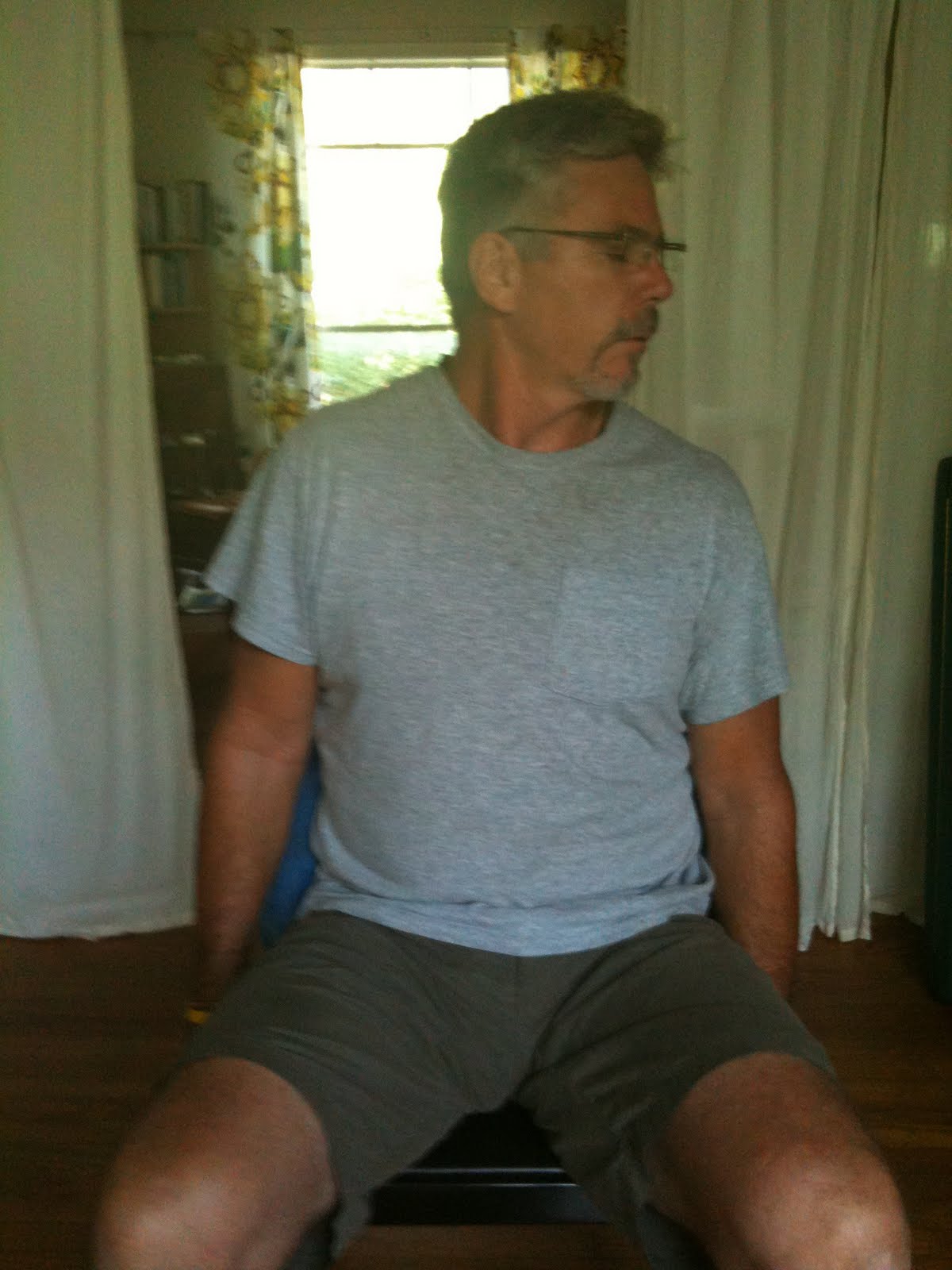
Here Vick raises his right shoulder, the one he chose to work with, and looks to the right.
Here he raises the same shoulder (through the lesson, always the same shoulder, then at the end, the perception of differences is the greatest)
6. Now rest
and notice a difference in feeling one shoulder to the other.
7. Now, and this is hard to show with a picture,
but LOOK STRAIGHT AHEAD, AND KEEP YOUR GAZE STRAIGHT AHEAD,
while turning your head first one way,
and then the other, slowly and gently,
as you raise the chosen shoulder gently.
As the nose comes back to forward, the shoulder comes down slowly and easily.
When doing this pay attention to four things:
your shoulder blade
your ribs
your neck
your eyes.
Rest after several times each way,
and feel differences,
in your whole being,
and differences
from one side to another.
8, Now while lifting, again
slowly and gently, the same shoulder,
one time tilt your head toward the lifting shoulder
and one time tilt your head away from the lifting shoulder
Do this several times, looking for pleasure and ease in your whole being,
and learning.
Rest and notice differences side to side.
9. Now shrug one shoulder and then the other and notice differences.
10. Just sit and feel yourself and notice differences side to side:
can you see differences here?
Here's Vick before the lesson: for starters:
You might be able to see differences side to side,
and in a general feeling of ease and relaxation.
But this is dynamic relaxation.
The shoulder on the right is a smarter,
more evolutionarily cool shoulder.
How to tell?
Well the pictures won't show much,
but you do it and you'll feel.
One at a time lift the arms forward and up
and see/ feel/ notice/ exult in which shoulder seems
like its younger and more vital and really part of "all of you,"
and which one's just "off on its own."
What would be a cool book to add to this lesson?
The Elusive Obvious, by Moshe Feldenkrais,
with its great section on "doing it right" as a dead end,
and "Doing it better," as a lifetime of improvement,
joy and discovery:
some pretty fun stuff to recommend now and then,
but the link was to one of these insulting;
Here's your body,
treat it like a machine and you can make it a better machine
kind of deals.
The big scoop: Raise up your shoulders, hold them there,
release. Do this a number of time,
daily,
and you can increase "Range of Motion."
Some other time I'll return to earlier rants
about how insulting "Range of Motion" is
as a goal for a real human being, but let's just think like
this for a minute:
We are one being.
We evolved from creatures living in nature
and needing to feed and defend and clothe and procreate
ourselves.
We have a brain,
perhaps the most amazing 2-3 pounds of matter
in the Universe,
and what is it concerned with as far as the amazing shoulder,
this joint that is barely a joint,
with the shoulder blades floating so freely on the back ribs:
bringing our hands to our mouth to feed ourselves,
throwing a javelin,
grabbing a tree branch to climb to safety,
reaching out to pick up our babies,
or hug and more our mates
or.....
"range of motion."
Can you begin to see how insulting it is
to
A. Our lives
B. our shoulders
C. our brains
D. our ability to learn and improve
to come up with some scheme to treat ourselves like a machine
that needs oily and improve
"range of motion?"
(Okay, there, I guess I didn't wait to rant,
did I?
If you enjoyed it, thanks.)
Okay,
so instead of shrugging up and releasing down,
what is the alternative for those of us with a brain
and the ability to lay down new neural pathways like crazy
(the so called brain plasticity,
that every live wire person who kept learning their whole
life knew about without knowing the name for it)
Okay, here goes:
I'll include some pictures,
and when I'm bored or something,
if that ever happens, add more, because it takes a long time to upload photos,
but here is a way of treating your shoulder
AND BRAIN
AND WHOLE LIFE TO IMMENSE IMPROVEMENT
So.
Just sit.
Feel yourself.
1. Then do the shrug thing, and lift both shoulders.
Okay that's the beginning comparison.
2. Intelligence and laying down new neurons only takes place
with awareness and noticing differences, so
Lift one shoulder
and then the other.
Do this several times and discover the differences
and what's the same.
3. Now pick one shoulder to improve.
Don't pick one that's in pain, but if it's past pain that no
longer is around, pick that one, if you want.
WHATEVER SHOULDER YOU PICK,
SO SLOWLY,
SO ABOUT 70% OF YOUR LIMIT,
SEARCH FOR AND FIND PLEASURE AND EASE THROUGHOUT
EVERY MOVEMENT.
4. Now just lift and lower the shoulder you picked,
noticing a difference between these two areas:
your shoulder blade
your ribs.
Go slow, slowly, slower.
Go gently. Notice the ribs not moving much,
and the shoulder blade rising and lowering.
Rest.
Notice differences one side to another just from that.
5. Now lift you shoulder, always this same one,
and very slowly turn your head to one side as the shoulder turns,
and then bring back to the middle as the shoulder descends.
Go back and forth,
notice differences.
Find pleasure to each side.
Time for a picture or two:
Here Vick raises his right shoulder, the one he chose to work with, and looks to the right.
Here he raises the same shoulder (through the lesson, always the same shoulder, then at the end, the perception of differences is the greatest)
6. Now rest
and notice a difference in feeling one shoulder to the other.
7. Now, and this is hard to show with a picture,
but LOOK STRAIGHT AHEAD, AND KEEP YOUR GAZE STRAIGHT AHEAD,
while turning your head first one way,
and then the other, slowly and gently,
as you raise the chosen shoulder gently.
As the nose comes back to forward, the shoulder comes down slowly and easily.
When doing this pay attention to four things:
your shoulder blade
your ribs
your neck
your eyes.
Rest after several times each way,
and feel differences,
in your whole being,
and differences
from one side to another.
8, Now while lifting, again
slowly and gently, the same shoulder,
one time tilt your head toward the lifting shoulder
and one time tilt your head away from the lifting shoulder
Do this several times, looking for pleasure and ease in your whole being,
and learning.
Rest and notice differences side to side.
9. Now shrug one shoulder and then the other and notice differences.
10. Just sit and feel yourself and notice differences side to side:
can you see differences here?
Here's Vick before the lesson: for starters:
You might be able to see differences side to side,
and in a general feeling of ease and relaxation.
But this is dynamic relaxation.
The shoulder on the right is a smarter,
more evolutionarily cool shoulder.
How to tell?
Well the pictures won't show much,
but you do it and you'll feel.
One at a time lift the arms forward and up
and see/ feel/ notice/ exult in which shoulder seems
like its younger and more vital and really part of "all of you,"
and which one's just "off on its own."
What would be a cool book to add to this lesson?
The Elusive Obvious, by Moshe Feldenkrais,
with its great section on "doing it right" as a dead end,
and "Doing it better," as a lifetime of improvement,
joy and discovery:
For a whole batch of movement lessons, click on the label below, there's sixty of so, I think
Anat's book, too, with its slightly watered down
but superb descriptions of the way we can keep improving our vitality
our whole life.
Thursday, February 24, 2011
Qigong part two, balance is not falling over, lengthening is reaching to heavens above and Earth below
Stand on the easiest foot
Bring the other foot back, and lightly use your toes to balance
Form a ball with your hands in front of your standing leg, opposite hand of standing leg on top
Reach up with top hand, down with other hand, arch your back, breathe out and lengthen
Come back to the ball near the hip of your standing leg with the other hand on top, ie same hand as standing leg
Then lengthen up and breathe out
Rest and do this to the other side
Now,
the advanced version
Stand on one foot; I'll say left to make it easier
Bring your right knee up toward your chest and your hands in a ball, about six inches apart,
right hand on top
Bend/ fold in a bit, so your stomach in back,
shoulders head and sternum down
pelvis tilted up (as in tailbone under, sex toward nose)
From this fold/ round/ crouch: breathe in
I know it's weird, but do it, breathe in,
and
breathe out
and lengthen,
right leg behind you and still in the air
right hand easily high above your head
arch your back
look up easily without shortening your neck toward your hand,
left hand down
Breathe in
and come into a crouch again
still on your left foot,
right knee forward again,
this time a ball with the left hand on top,
Breathe out,
lengthen left hand high, right hand down,
right leg back again,
Do this back and forth about 3 times.
Then switch to standing on your right foot
and reverse everything
Bring the other foot back, and lightly use your toes to balance
Form a ball with your hands in front of your standing leg, opposite hand of standing leg on top
Reach up with top hand, down with other hand, arch your back, breathe out and lengthen
Come back to the ball near the hip of your standing leg with the other hand on top, ie same hand as standing leg
Then lengthen up and breathe out
Rest and do this to the other side
Now,
the advanced version
Stand on one foot; I'll say left to make it easier
Bring your right knee up toward your chest and your hands in a ball, about six inches apart,
right hand on top
Bend/ fold in a bit, so your stomach in back,
shoulders head and sternum down
pelvis tilted up (as in tailbone under, sex toward nose)
From this fold/ round/ crouch: breathe in
I know it's weird, but do it, breathe in,
and
breathe out
and lengthen,
right leg behind you and still in the air
right hand easily high above your head
arch your back
look up easily without shortening your neck toward your hand,
left hand down
Breathe in
and come into a crouch again
still on your left foot,
right knee forward again,
this time a ball with the left hand on top,
Breathe out,
lengthen left hand high, right hand down,
right leg back again,
Do this back and forth about 3 times.
Then switch to standing on your right foot
and reverse everything
this will do ya
good
ciao
chris
Thursday, January 08, 2009
"tucking the pelvis under"
"tucking the tailbone under"
in Tai Chi
in Yoga
in whatever
lots of people
recommend this
I don't
unless you are coiling into
to expand/ punch/ push
outward afterward
Labels:
brains,
learning vs. doing it "right",
pelvis,
Tai Chi
Saturday, January 05, 2008
Excerpt From: UP, Improve Mood, Posture, Thinking, Backs, Necks and Sex, ...and Help "Save the World"
AND THEN WHAT? (in book, paragraphs are "regular," here I spread things out, for easier viewing in computerland)
These prior 4 activities/ meditations/ practices/ lessons (first four of 21 activities that will be in the book) will increase your awareness of how you fit together as a human being on this planet Earth.
They will bring you into the present.
And soften and moderate your breathing.
And will lengthen your spine and improve your posture.
By involving your pelvis they will increase your sexual awareness and skill.
By involving your attention and thinking and awareness they will help you to solve problems better.
By connecting more of you to more of you in pleasant and watchful ways, they will increase your ability to love yourself.
This way of learning and exploring and discovery is ancient to our lives. It is the way we learned when we were infants and the best learners we’ve ever been. When we discovered how to crawl and roll over and walk and talk, we were little geniuses. We didn’t have a program of action, we didn’t do what we were told. Rarely, at least in the first movements, did we imitate anyone. (Speech required a lot of imitation, and yet: it also was hugely about “playing around” with sounds and discovering how to make the noises we heard out there.)
This way of discovery will access our brains, and call us back into solving real and literally tangible “problems.” How to move the head down as the belly comes forward and the head up as the back comes back, is a real feat of attention, and awareness.
And learning.
Learning as discovery.
This is how this work can be anti-aging, by reconnecting us to that young state of heightened learning and awareness, where we are pouring on the new cells in our brains.
When we learn one of these new and complicated movements, we are doing just that: laying down millions of new brains cells.
When we make the new, we become as if young again.
Aging, so called aging, can be seen mainly as a solidification of old and familiar and unaware patterns. We move and talk and sit the same way, wearing down mental and movement and emotional and speech groves (ruts) that tend to get a little more rutted and stuck each year. We think the same things, say the same things, do the same things, have the same reactions to the same situations.
We become predictable and programmed, and boring, although we probably don’t realize that.
So, now, these activities offer a chance to move beyond old habits and get back in the way of living where being present, and being curious and discovering are what our lives are all about.
what are these activities??
come to a Sufia yoga class, or movement class
and find out.
It's so much
fun
and you
really do
expand
change
learn
and become better able
to love yourself
These prior 4 activities/ meditations/ practices/ lessons (first four of 21 activities that will be in the book) will increase your awareness of how you fit together as a human being on this planet Earth.
They will bring you into the present.
And soften and moderate your breathing.
And will lengthen your spine and improve your posture.
By involving your pelvis they will increase your sexual awareness and skill.
By involving your attention and thinking and awareness they will help you to solve problems better.
By connecting more of you to more of you in pleasant and watchful ways, they will increase your ability to love yourself.
This way of learning and exploring and discovery is ancient to our lives. It is the way we learned when we were infants and the best learners we’ve ever been. When we discovered how to crawl and roll over and walk and talk, we were little geniuses. We didn’t have a program of action, we didn’t do what we were told. Rarely, at least in the first movements, did we imitate anyone. (Speech required a lot of imitation, and yet: it also was hugely about “playing around” with sounds and discovering how to make the noises we heard out there.)
This way of discovery will access our brains, and call us back into solving real and literally tangible “problems.” How to move the head down as the belly comes forward and the head up as the back comes back, is a real feat of attention, and awareness.
And learning.
Learning as discovery.
This is how this work can be anti-aging, by reconnecting us to that young state of heightened learning and awareness, where we are pouring on the new cells in our brains.
When we learn one of these new and complicated movements, we are doing just that: laying down millions of new brains cells.
When we make the new, we become as if young again.
Aging, so called aging, can be seen mainly as a solidification of old and familiar and unaware patterns. We move and talk and sit the same way, wearing down mental and movement and emotional and speech groves (ruts) that tend to get a little more rutted and stuck each year. We think the same things, say the same things, do the same things, have the same reactions to the same situations.
We become predictable and programmed, and boring, although we probably don’t realize that.
So, now, these activities offer a chance to move beyond old habits and get back in the way of living where being present, and being curious and discovering are what our lives are all about.
what are these activities??
come to a Sufia yoga class, or movement class
and find out.
It's so much
fun
and you
really do
expand
change
learn
and become better able
to love yourself
Subscribe to:
Posts (Atom)