Showing posts with label brain. Show all posts

Monday, August 18, 2014

Shoulders


What is a shoulder?

That stuff up at the edge of the torso, right?

But, what is that stuff?

Take one hand and feel around on the other shoulder. See if you can find the ribs below your armpit, and then if you go around to the back, there's something over the ribs.

That's your shoulder blade.  See if you can feel where the ribs start being covered by the shoulder blade. Wiggle the shoulder a little to help.

See if you can feel the shape of the shoulder blade. It's kind of like an upside down triangle, a bit far fetched to become an angel's ( or bird's) wing, but hints of that.

It just floats, on the ribs, this shoulder blade, and comes up over the top, and has a part of it that we call the collar bone, and that attaches to the sternum.

Gad. Is that too much anatomy?

Well, wiggle it around some more. That attachment at the collar bone and sternum is the only place it's not free, so the shoulder theoretically has a lot, a lot, a lot of possibility for movement.

If you play tennis, golf, a musical instrument, dance with a partner, hug, this move-ability comes in handy.

And shoulders are extremely easy to improve via the work I do. 

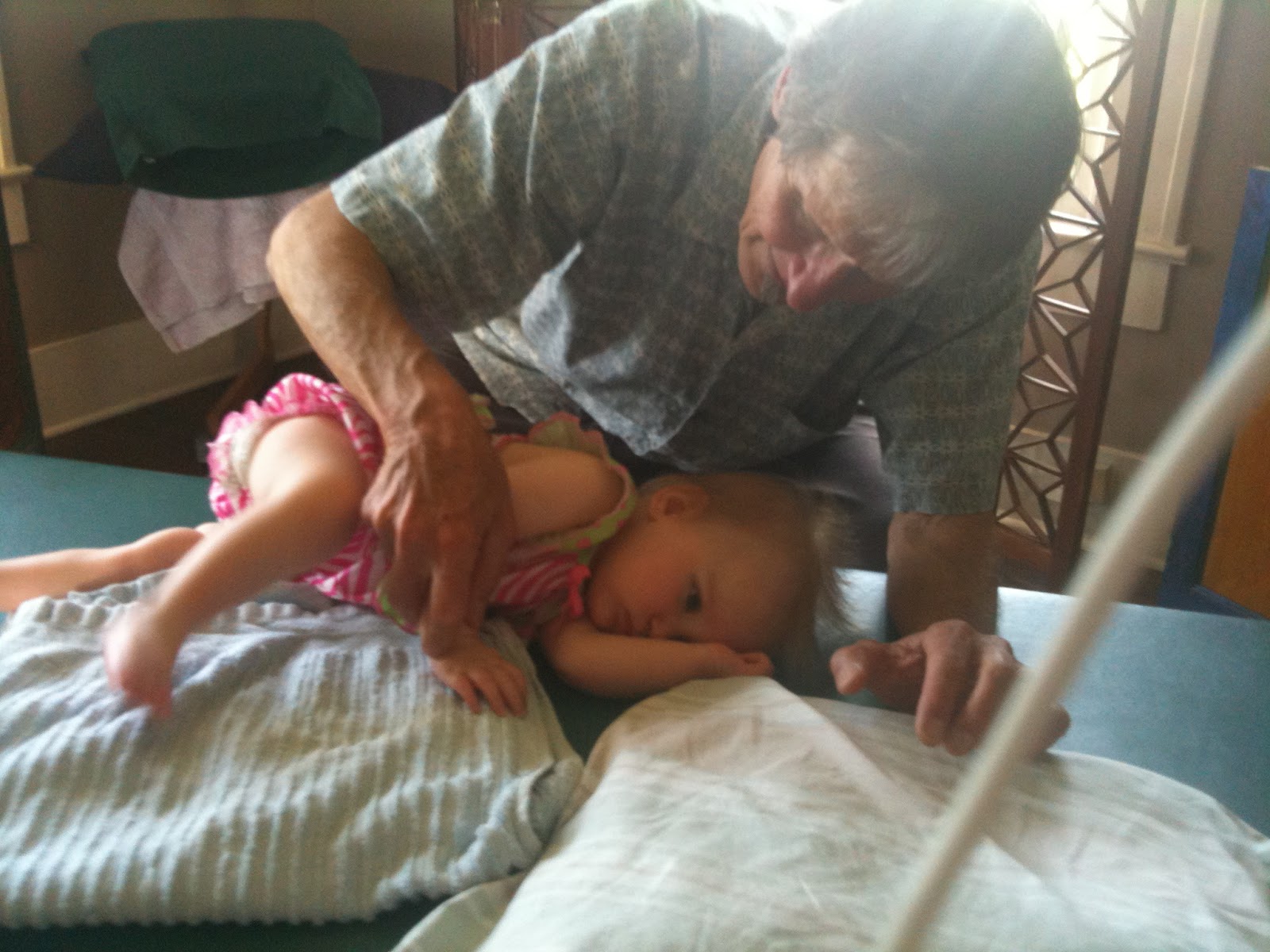
The left shoulder above, was that of a quite lovely lady carpenter, who was bed ridden in back and shoulder pain, and after a series of lessons, got up and build herself and her daughter a house, while working other jobs. 


Do you have shoulders, or another part of you, that would like to be better in ease and action?

Tuesday, July 22, 2014

Movement, Love, Mindfulness, day 1--- wake up breathing

move the ribs and you will
wake up breathing

go slowly
breath is in no hurry

add
on the pelvis
attached to the spine
attached to the ribs

more ease
more awakened breathing
more pleasure
more life

good....


So,
lie on your back, on a comfortable floor or a bed or some grass, sand
you figure that out

1. Move your head
gently side to side

feeling what happens in your neck
feeling the difference in feeling in moving the two ways
feeling yourself slow down
and
pay attention

do this many times

1.b. Rest
Just sense yourself
Breathe

2. Move your feet,
side to side
like windshield
wipers

slowly
and here again,
feel the movement,
feel differences side to side
feel yourself paying attention

2.b. rest

3. Now,
in various combinations,
either move the feet and the head the same way,
or opposite ways

take lots of time to explore and enjoy this

3.b. rest

4. take your hands to the opposite armpit
and very very gently move your ribs right and left

feel the movement in the front
and
back of your ribs
feel the movement in your neck and pelvis

enjoy
notice
go slower

4.b. rest

5. Create this interesting combination:
head and feet to the left
as ribs go to the right,
and

head and feet to the right
as ribs go to the left

notice
enjoy
learn
sense yourself

breathe

5.b.
rest

there is lots more involving the pelvis
call for a lesson over the phone,
360-317-4773
or go find a nearby Feldenkrais® or
Anat Baniel Method practitioner

and this is a start

notice
ease and
improvement in your breathing from this


Thursday, June 12, 2014

Insomnia

The trick with insomnia is this:

Don't fight it

Don't think about it...

Don't worry...

Easier to say than to do,
and
this is your chance to learn to meditate
whether you want to or not

...

this is the secret:
finding something soft and eyes closed
that is more interesting than thinking

a lot more interesting

and guess what:

movement with attention
that is slow
and had variation
and is soft
and had breaks/ rests/ pauses

suits that requirement completely

...
so
here's a good one,
and it helps with necks, backs and shoulders, too.


lie on your side,
in bed
eyes closed,
knees bent comfortably and one hand on top of the other
with your arms straight
in front of you

do things and then rest

1. take your top arm forward ( the direction your nose is pointing is forward)
so that your top hand goes past your bottom hand
do this very slowly

keep this top arm straight and bring the hand and arm back, so the fingers begin to come
up on your lower wrist

go back and forth and feel the movement in your shoulder
and your back

rest

2.
Do all the above and add on breathing
either way:
breathe in as you go forward and out as you come back
or
breathe out as you go forward and breathe in as you come back

do this slowly
about ten times,
seeing if you can feel something new and different and pleasant
in your body each time you do this

rest

3. Do all the above
and start opening your hand like a flower as you roll forward
and bringing all your fingers together like an octopus all legs touching as you come back
go
slow
go
really really slow

feel
the fingers
feel
your breathing
feel your ribs rolling
feel
you shoulder blade moving
feel
the
vertebrae in your spine moving

feel
the pleasure in
feeling/ sensing yourself

at least ten times rest

after those four ,
lie on your back and rest
and imagine the whole sequence in your mind
as you feel rather than do it in your body

then do it again,
but add on:

be aware of your neck
feel how it rolls a little one way and the other

do all four steps
one by one,
nice long rests,
and have your neck as part of this

after those four,
take a big rest


if you want more complicated versions,
come take lessons
or call
and we'll arrange verbal lessons if you aren't in Austin..

but keep doing this
as you get more and more happy
and soft with
fingers
spine
neck
shoulder
ribs
breathing

take lots of rests

do it a bunch on one side
so slowly than you can imagine,
almost like it's sleep movement

take lots of rests

you might fall asleep

that's okay

you might keep enjoying this
and
radically improving your spine neck shoulder and brain and fingers

that's okay, too

smile while you do this
sense your toes
and send happiness to them,
and let them send
happiness to you

good,
cheers
chris

Monday, May 19, 2014

Subtle, one of Anat Baniel's nine essentials. the Monday essay in the kids blog


Subtlety means, using less force. Less effort. Less noise. Less intensity.

As always, this is about your child's brain.
And as always, this is about your chance to radically improve your own life and awareness as you are helping your child.

If you carry a heavy book in your hand, and someone adds a pen, you won't feel the weight of that pen.
If you carry an envelope and someone adds a pen, you'll feel the difference.

If you light a match across a sunlit field, you might not see it at all.
In the dark, it will be bright and clear.

Too much background "noise" / information, and our brains can't pick up the little details,
the smaller level of information that is needed.

Her Anat Baniel says it on 113, again, the key to this all:

The brain's ability
to perceive fine differences
is at the heart
of its ability to generate new information
for organizing new,
more refined, and
more exacting action
and for overcoming limitations.

If the brain doesn't perceive the difference, it doesn't exist for that person.
Too much background intensity, and the learning can't take place.

Anat then tells the story of a little girl with cerebral palsy who had had enough overzealous lessons, that she reacted to all attempts at movement, her own attempts or others attempting to move her, with excessive and powerful curling up into a ball.

Anat discovered that had to play the L A Z Y game, to begin to get the girl's brain to allow her to experience small and different movements without shifting into excessive force and contraction.

This took awhile, but once it happened, the learning was rapid and clear.

Think of what we've learned so far:
SLOW , VARIATION, MOVEMENT WITH ATTENTION

Say you are moving a child's arm up and down, and then sideways, horizontally.
Clear differences.
Highly useful to a child who didn't use her arms well.
And you could be slow.
And you've got the variation of side to side and up and down.
But it you are yanking with great force the two variations, even if slow, the child is just going to feel the excess, and no learning is going to take place.

Differences.
We are feeding the brain, ours and our children's, differences.

Vary what we do.
Go slow.
Use as little force as possible.

Make it something the child can grasp with his attention.

This is for you and for your child.

( There is a bit in here about letting a child learn numbers. It's better to read it all. The point is that thinking is organizing the world from perceived differences, and once the child understood the fundamental idea of numbers he went from clueless to loving math)

For you:
Move more gently when you touch your child.
Keep your emotions down if provoked. That just adds fuel to the fire.
It's all about being sensitive to how little effort you can put into making movement or speech or action.
Effort in the sense of excessive force. This isn't about being a slug.

And for your child:
Keep their movement within their comfort.
Try to feel how they are feeling things.
Encourage games where the play with loud/ quite, or firm grasp/ light grasp.
Even you: light pressure, firm pressure on their leg say.

There is a wonderful example of a child having trouble walking because she isn't sure if her feet are under her hips, outside of them, or inside.

Instead of trying to create this learning when she's got all the effort of standing, sit her down, and play games with feet closer and farther apart. One foot moving. ( Eyes closed) Which foot was it? Did it move in or out.
And on and on.

Slow here too, and variation, but with the more subtle zone of sitting , so she can notice differences.

Treat yourself and your child like a Stradivarius. The brain can do amazing things. Make it easy by being as subtle as you can.

And enjoy it.

This is fun.

Tuesday, March 11, 2014

eyes necks and backs

This is a snippet of a lesson

Come to table lessons
and this will be a reminder

This work is deep

Quick and amazing,
and you need depth to really come to the fullness that it can bring....


One: Lie on your back
Close your eyes

Feel the right leg
Feel the left leg
Feel your spine

Feel your pelvis and your ribs and your arms

Two:
Bring your feet to standing
and let your knees move to the right

as you do this push out your belly
and breathe out

then bring your knees back to the center

do this at least ten times,
enjoying each time

rest

Three:
Do all that while alternating turning your head to the left
and
your head to the right

Rest

Four:
Put your palms over your eyes and do all the above
with your eyes in the dark
and feeling your pelvis
and
your ankles
and
your neck
and the softness in your eyes as they are covered

rest

Five
Do all the above and let your eyes go in to opposite way that your head goes
Do this slowly
and
softly
at least ten times

enjoy each movement
and relax between each one

rest
lie out long and feel how your body and state of being have changed

rest longer

then
bring your feet to standing
and

imagine doing these steps with your knees come the other way

then do them

rest after each step

rest about ten minutes at the end

then
get
up

and take a walk
outside in the weather is nice
on
uneven ground if you can find any


good

Wednesday, February 19, 2014

Flexible Hearts, Brains, Bodies and More

e="clear: both; text-align: center;">

Flexible Brains, Hearts and Lives.

What are brains for?

Learning.
Learning what?
How to stay out of trouble. Hence habits that we cling to since they once “worked” to avoid some problem.

And, learning how to be happier, or do something better. As early as learning how to roll over, crawl and walk. Our brains learned that. How to get along with others. How to have a good time. How to make friends. Our brains learned that.

And now, what would YOUR brain like to learn?

And how could being flexible in your approach radically accelerate your learning?

Learning is what? Let’s get this amazingly useful concept front and center: 
Learning is the noticing of a difference that makes a difference.

That’s worth repeating: Learning is the noticing of a difference that makes a difference.

Let’s take three kinds of learning that might point toward a better, more enjoyable, more potent life.

Emotional.
I’m sure this doesn’t ever happen to you, but some people are known to have people in their lives who annoy them.
To use a brain to change this around, let’s toy with a central variable in how people perceive others who annoy them.
They think the annoying one is wrong and should change.

Okay, if this were about flexible hearts, we could hint at saintly behavior and loving the annoying ones anyway.
But, let’s use the brain systematically  to try other ways of dealing with this.

One, what if the annoying one is not wrong. Wait, wait, this doesn’t have to be believed. Just tried out.
So, one difference: they aren’t wrong.

Difference two: what if, in some small and almost infinitesimal, we are wrong.

Difference three: what if, again, in some small and almost infinitesimal way, there is some change we might bring into the equation.

( Hint: it’s usually to change in the way we want them to change. But that’s a bigger story. This story, is that letting our brains change the construct around gives us a vastly more free and perhaps congenial way of relating to an “annoying” person.

Movement.
This, of course, is the stock and trade of the Feldenkrais® work. So we need only the slightest example, since all the lessons, thousands of them, require a flexible approach to movement, that results in large improvement, by varying something, often varying something rather small.

So, we want to turn to the left to see better over our left shoulder in a sitting position. This could help driving safety,  say.

The old model, is to yank our neck to the left, and then yank a little more.

One variation that is yank free, would be to put the back of our right hand on our left check, and with the hand there, turn to the left in a way that involves our right shoulder and our ribs.
And the turning is easier.

A second variation.
Push your right hip forward so that your pelvis rotates to the left. Do this as you look to the left. See if that is a difference that makes a difference.

A third, and this is similar to the first, but I like it because it’s so self-friendly. Hug ourselves by holding the opposite armpit with each hand. ( Figure it out. It feels good).
In this hug, rotate our ribs to the left as we look to the left.

Finally. Using the self hug, and our right knee forward at the same time, rotate our face and ribs and pelvis to the left and notice the ease and increase in this movement.


Problem solving.
This is a little trickier, since we don’t have a specific problem, and let’s have flexible brains and play with this too.

One variation:
Think of three ways to make the problem even worse. How could we lock it down and make it more intractable?

Two:
Think of three really silly ideas, that have no merit whatsoever, apparently, but write or doodle them out.( Robbing a bank to make more money, say)

Three:
Come up with three possible new approaches, that go against the first variations, and create any small shift.That is: whatever would make it worse, do less or the opposite and doodle, write, brainstorm them out into the world of though experimentation.

Four:
Find the one of the most promising of these ways and find ways to make even smaller sub changes toward making that happen.

This is perhaps too abstract.
Alas, that is one thing brains are good at : thought experiments. You could use your brain to try out the third example in your own real life and your own real variations.

Or, you could skim on to the next thing.

Flexible brains get to make decisions.
Aware brains, know when the decision is being made.

It’s your brain. Enjoy it.

It’s your awareness. Thrive from it.

Flexible Brains for Hearts, Bodies and Problem Solving


Flexible Brains, Hearts and Lives.

What are brains for?

Learning.
Learning what?
How to stay out of trouble. Hence habits that we cling to since they once “worked” to avoid some problem.

And, learning how to be happier, or do something better. As early as learning how to roll over, crawl and walk. Our brains learned that. How to get along with others. How to have a good time. How to make friends. Our brains learned that.

And now, what would YOUR brain like to learn?

And how could being flexible in your approach radically accelerate your learning?

Learning is what? Let’s get this amazingly useful concept front and center: 
Learning is the noticing of a difference that makes a difference.

That’s worth repeating: Learning is the noticing of a difference that makes a difference.

Let’s take three kinds of learning that might point toward a better, more enjoyable, more potent life.

Emotional.
I’m sure this doesn’t ever happen to you, but some people are known to have people in their lives who annoy them.
To use a brain to change this around, let’s toy with a central variable in how people perceive others who annoy them.
They think the annoying one is wrong and should change.

Okay, if this were about flexible hearts, we could hint at saintly behavior and loving the annoying ones anyway.
But, let’s use the brain systematically  to try other ways of dealing with this.

One, what if the annoying one is not wrong. Wait, wait, this doesn’t have to be believed. Just tried out.
So, one difference: they aren’t wrong.

Difference two: what if, in some small and almost infinitesimal, we are wrong.

Difference three: what if, again, in some small and almost infinitesimal way, there is some change we might bring into the equation.

( Hint: it’s usually to change in the way we want them to change. But that’s a bigger story. This story, is that letting our brains change the construct around gives us a vastly more free and perhaps congenial way of relating to an “annoying” person.

Movement.
This, of course, is the stock and trade of the Feldenkrais® work. So we need only the slightest example, since all the lessons, thousands of them, require a flexible approach to movement, that results in large improvement, by varying something, often varying something rather small.

So, we want to turn to the left to see better over our left shoulder in a sitting position. This could help driving safety,  say.

The old model, is to yank our neck to the left, and then yank a little more.

One variation that is yank free, would be to put the back of our right hand on our left check, and with the hand there, turn to the left in a way that involves our right shoulder and our ribs.
And the turning is easier.

A second variation.
Push your right hip forward so that your pelvis rotates to the left. Do this as you look to the left. See if that is a difference that makes a difference.

A third, and this is similar to the first, but I like it because it’s so self-friendly. Hug ourselves by holding the opposite armpit with each hand. ( Figure it out. It feels good).
In this hug, rotate our ribs to the left as we look to the left.

Finally. Using the self hug, and our right knee forward at the same time, rotate our face and ribs and pelvis to the left and notice the ease and increase in this movement.


Problem solving.
This is a little trickier, since we don’t have a specific problem, and let’s have flexible brains and play with this too.

One variation:
Think of three ways to make the problem even worse. How could we lock it down and make it more intractable?

Two:
Think of three really silly ideas, that have no merit whatsoever, apparently, but write or doodle them out.( Robbing a bank to make more money, say)

Three:
Come up with three possible new approaches, that go against the first variations, and create any small shift.That is: whatever would make it worse, do less or the opposite and doodle, write, brainstorm them out into the world of though experimentation.

Four:
Find the one of the most promising of these ways and find ways to make even smaller sub changes toward making that happen.

This is perhaps too abstract.
Alas, that is one thing brains are good at : thought experiments. You could use your brain to try out the third example in your own real life and your own real variations.

Or, you could skim on to the next thing.

Flexible brains get to make decisions.
Aware brains, know when the decision is being made.

It’s your brain. Enjoy it.

It’s your awareness. Thrive from it.

Tuesday, February 11, 2014

Balance Two, for You

Stand near a wall>

Decide which foot is your stable foot,
and which your free foot

Stable is usually right for left handers, and left for right
Free is usually right for right handers, and left for left

Lift one foot

That one's your free foot

Stand a foot and a half or so from the wall,
adjust so that you feel moderately or a lot comfortable
leaning the top of your head into the wall

Use your hands for support if need be

ONE
Bring your free foot behind your stable foot,
so that it is on the opposite side that it usually is
and
both feet are pointing toward the wall

Shift your weight very slowly from right to left
and then back
Many times
Feel the transition as if 10%, 20%, 30% in one foot
as the weight gets more very gradually

Enjoy this
and notice how different it is to have the weight to your left side
on your right foot
and
the weight to your right side
on your left foot

Rest
by gently pushing to upright
and leaving the wall to walk around a bit

TWO
Everything as in One
same foot behind,
and now shift the weight from heels to toes
and back

Many times

Rest with your head on the wall

Now, do a circle of weight distribution:
Left heel, left toes,
Right toes, right heel
Many times,
and
then
reverse the circle

Now the longer rest, standing and walking

THREE:
Put the free foot in front and across to the other side
again, both feel pointing to the wall

and do the three stages from above;

Left and right

Front and back

Around the circle in both directions

Stand and walk for a rest

FOUR:
Take your stable foot behind the standing foot and to the opposite side
and
do all three

then rest and stand and walk

FIVE
Take your stable foot in front of your free foot and to the opposite side
and
do
all three:

Right and left
Front and back
Around the circle in both directions

Rest by walking and stay out of normal actions for awhile

Take a walk outdoor is you can,
though it's cold this time of the year most places

Monday, February 10, 2014

Balance: a movement lesson

This is fun for all
and especially useful for people who are getting older,
who have fallen, or been in an accident,
or had a stroke,
and wish to improve their balance.

There will be one today,
and another tomorrow.


One:
Stand near a wall, about a foot and a half away,
( You can adjust this)
and putting your hands on the wall,
and then

bow a bit forward
so that you can press the top of your head into the wall

Rest here a bit
and feel the weight of you going up from your feet
through your spine
through your skull
into the wall

After you are comfortable,
begin to shit your weight from your right foot
to your left foot
back and forth,

Rest

Now shift your weight left and right
Very slowly
with a lot of pleasure and attention
and

as you shift to the right,
raise your left heel and rotate your left foot to the right
and

rotate your pelvis to the right,
and
rotate your head to the right, so your nose is pointing to the right.

and as you come back
bring your head to the middle
and both feet on the ground

and as you go to the left
raise your right heel
and rotate that foot and hip to the left
and rotate your nose and head to the left

if you can do this with your arms dangling down,
fine

if you need to keep your hands on the wall steadying you
that's fine too

many times,
at least 12
as many as you like

go for each time feeling slightly different
and each time more awareness of a new part of
yourself
and each time
a deeper sense of ease and pleasure

rest, but slowly using your hands to stand upright,
and walking around a bit


TWO;
You are going to do everything you did in the more
complicated version,
except that your head is going to go
the opposite way of the rotation of your hips
that is happening from the weight shift
and raising your heel

so:
rotate your pelvis to the left
by raising your right heel
and rotating your hip and leg to the left,
and
as you do this
(slow, slow, slow, slowly, slowly)
take your head and nose to the right

and easily slowly gently reversing this
so that as your pelvis goes to the right
with your left heel raising, and your left leg and hip rotating,
your head goes to the left

this won't be easy
and
if you go slowly enough
with enough attention,
will profoundly reorganize your nervous system
to balance far better in gravity

rest as above,
coming off the wall and walking around


THREE:

This is a fuller version of the second part of ONE

with your right hand on the wall, and your right hand dangling down,
and the top of your head on the wall,
rotate to the right by lifting your left heel,
rotating your hip,
turning your nose and head to the right,
and this time
the nose and eyes will be following the loose right hand, and arm,
which will rotate up to shoulder height to the right

then reversing down and the other way:
the hand will come down
and up to the left
the right heel will raise
the hips and leg will rotate to the left
as the head and nose and eyes follow your hand

back and forth
many times,
slowly
gently
pleasurably
with ease and
breathing
and discovery
and grace

rest as before by walking around

FOUR:
The same as above with the other arm

as the pendulum that goes side to side
followed by your eyes and nose

enjoy this,
really
slowly
completely
easily
slowly
gently

breathe
breathe
breathe

Take it easy for 10-30 minutes after and let this integrate

Naps and walks are the best integration
Good

Thursday, January 30, 2014

Movement for back, hips, neck and brain---cat and cow

CAT AND COW
IN SITTING ON A CHAIR
Come to the front of the chair
Both feet on the floor

CAT:
Back is rounded
by
Pulling stomach in
Rolling back on your pelvis
Lowering your sternum
Letting your head slump down

COW
Back is arched
by
Pushing stomach forward
(extra credit, figure out how to do this on the outbreath)
Rolling forward on your pelvis
Raising your sternum
Letting your nose lift up toward the sky (Do not cram your neck way back)


NORMAL DEAL
In sitting
alternate cat and cow

slowly
taking a few turns to mainly notice the pelvis
a few turns
to mainly notice the ribs and arch/ round of the spine
and
a few turns
feeling your head's involvement in this
and
then
a few turns feeling it all together

VARIATION ONE

In this variation your head does the opposite as the "normal" version

So
VARIATION ONE -- CAT
All is the same except for the head:
Back Rounded
by
Belly in
Pelvis rolled back
Sternum down
and
Head goes UP this time

Two ways to notice this:
The head goes back as the back goes back
and
Your head is rotating the same way your pelvis is

VARIATION ONE -- COW
All is the same except for the head
Back Arched
by
Belly forward
Pelvis rolling forward
Sternum up
and
Your HEAD goes DOWN this time

as before;
Head and belly going forward
and
Your head is rotating the same way your pelvis is

LINK THESE UP:
AND
go slowly
and pay attention
and enjoy the movement
and find something new and delicious
and interesting
each time you do the movement

Go LESS than your full range
Use LESS force
Use MORE attention, ease and pleasure

Enjoy


CAT AND COW AS THEY DO IT IN YOGA

ON YOUR HANDS AND KNEES

NORMAL CAT
Back arched up toward the ceiling
as
Pelvis tucks under
Belly tucks in
Head lowers toward the pelvis
And your sternum moves as if down into your belly

NORMAL COW
Back and ribs come toward the floor
as
Your pelvis rotates so your butt is moving toward the back of your head
The back of your head , as you nose lifts, is moving toward your butt
Your sternum is expanding and coming as if up toward your neck

CAT and COW in Yoga:
Go back and forth between these two

VARIATION TWO
Put your weight on your left hand and knee
Have your right knee free

As you do cat,
Bring your right knee toward your nose

As you do cow
Bring your right foot back and up toward the ceiling

Alternate these two


VARIATION ONE IN THE YOGA VERSION

HANDS AND KNEES VARIATION ONE,      CAT
Your back is up toward the ceiling,
Rounded we call it, though blah blah, it could seem an arch
Think of rounding forward in standing or sitting,
This is rounding, just go along with it

Your back is toward the ceiling
Your pelvis is tucked under , tailbone tucked under, as if toward your head
Your belly is pulled in and up toward the ceiling
and
Your head is looking up toward the ceiling/ sky also

as before:
the back and the head are both toward the sky
and
the pelvis and the head are rotating the same direction

HANDS AND KNEES VARIATION ONE,    COW
Your back is arched
Meaning ribs are pushed "forward" if forward is the way your chest points
or
Ribs and belly are pushed toward the floor
and your sternum lifts a bit toward your neck
and
Your pelvis rotates as if the point your butt toward your head
and
Your head this time is
Going down toward the floor

as before:
The ribs and mid section is toward the floor and so is your head
and
Your pelvis and your head are rotating in the same direction

Combine these two
Go slowly
Go slower
Stop a lot

Feel it
feel it
feel it

as sensation

it's very relaxing
and
brain expanding

as are
all of these lessons

cheers
Chris

Saturday, January 25, 2014

Movement Lesson, for back and neck, in bed, and easy


MOVEMENT ONE: ON THE BACK


1.   Lie on your back, with legs comfortable, and head slightly supported so your neck is a continuation of your spine

Rotate your feet, right and left.
Gently. Easily. Many times.
Feeling this in many places: your ankles, your legs, your hip joints, your pelvis, your spine
Feel this as pleasure, ease, awareness and discovery

Rest
In all rests, scan your body for ease, pleasure and differences from earlier.

2. Bring your left arm across your face so that the crook of your left arm is over your forehead>
Slowly move the left arm right and left so that your head moves left and right, so that your nose rotates left to right.
Feel this as ease and pleasure, and notice as much of yourself as you can.

Do this many times, each time with a slightly different awareness focus.

Rest.

3. Have the left arm as in 2. And move your feet and arm

a. Many times with the head and the feet going the same direction>

Rest

b. Many times with the head and feet going in opposite directions>

Rest

4. Do all the above in 3.b, with the eyes going opposite your head and the same direction as the feet.

Breath . Notice. Enjoy.
Many times.

Rest. Get up and walk around as part of your rest.
And, JUST ENJOY being in your body.
This can be the end of a mini lesson, or, add in the next

5. As much as you wish, do all the above with the right arm.

Remember: no moves that are painful.
less is more.

Good.

Friday, January 24, 2014

Back, toes, spine, pelvis, neck and nose: an easy wake up play


MOVEMENT ONE: ON THE BACK


1.   Lie on your back, with legs comfortable, and head slightly supported so your neck is a continuation of your spine

Rotate your feet, right and left.
Gently. Easily. Many times.
Feeling this in many places: your ankles, your legs, your hip joints, your pelvis, your spine
Feel this as pleasure, ease, awareness and discovery

Rest
In all rests, scan your body for ease, pleasure and differences from earlier.

2. Bring your left arm across your face so that the crook of your left arm is over your forehead>
Slowly move the left arm right and left so that your head moves left and right, so that your nose rotates left to right.
Feel this as ease and pleasure, and notice as much of yourself as you can.

Do this many times, each time with a slightly different awareness focus.

Rest.

3. Have the left arm as in 2. And move your feet and arm

a. Many times with the head and the feet going the same direction>

Rest

b. Many times with the head and feet going in opposite directions>

Rest

4. Do all the above in 3.b, with the eyes going opposite your head and the same direction as the feet.

Breath . Notice. Enjoy.
Many times.

Rest. Get up and walk around as part of your rest.
And, JUST ENJOY being in your body.
This can be the end of a mini lesson, or, add in the next

5. As much as you wish, do all the above with the right arm.

Remember: no moves that are painful.
less is more.

Good.

Tuesday, January 21, 2014

More Moving, on the Side, Shoulder, Hip, Brain

Redo, if you have time, yesterday's lesson
and then add this on

Lying on your right side,
a bed
a firm floor with a blanket or several layers of yoga mat on it
a lawn

Today
have your left knee on top of your right knee
either put your right hand
or a cushion of some sort between the knees to ease the movement of the top knee

Have your left arm straight forward from your head on the ground/ floor ( we'll call it floor from now on)

1. Move your left arm slowly forward
and as per yesterday,
forward is the direction your chest is pointing

have the shoulder, your shoulder, move slowly forward and back to neutral
feeling this as a rolling in the top part of your spine
go slowly
and enjoy feeling each vertebra as it gets involved

rest

1.b.
Move the left arm forward and a bit down,
say a 45 degree angle
and as you do this
pull in your stomach muscles
and round your back a bit
then return to neutral

do this a number of times

rest

1.c.
Move your left arm forward and up a bit,
again, about 45 degrees,
and
as you move it forward and up,
arch your back
let your back seem to be pushing your arm
away
( it is),
feel the sternum lifting as you do this

return slowly and with awareness to neutral
and then do this many times

rest on your back and notice differences
side to side

return to your right side after a pleasant rest

2. Move your left leg ,
just a little bit,
straight ahead,
as if tipping off the right knee
and then come back

feel this as pure rotation
and feel the vertebrae move one by one

do this many times

rest

2.b.
Move your knee back and down
not a whole lot
but enough to feel how this works
well with push the belly forward
and arching your back

come back to neutral
go
very
slowly
and feel the back hip knee connection

back and forth,
from no arch and the knee on top of the other,
to arch and the knee back and down

rest

2.c.
Move your knee back and up a bit,
as if you were curling in
and bringing your knee toward your chin
and with this pull in your belly and round your back  a little
so the knee is coming back with a feeling of
curling up in the middle

rest on your back
enjoy the sensations
notice the differences:
beginning to now
right and left sides

stay here awhile,
and then
back to your right side

3.
arching

in extension,
in arching,

move your arm up and forward
while your arch your back
and lift your sternum
and
while you
bring your knee back and down a bit

as if you could keep going into a yoga like thing
with the arm toward up and the leg coming behind you

rest

4
rounding,
belly in

rounding,
flexion

this time
bring your arm down and forward
and your belly in
and bring your knee back and down

( the knee back and down is quite odd
go slowly
and figure it out

go very small
and have everything rotating around your movement being led
by your belly coming in

rest

5. Finish off with extension again
it's more natural

arm forward and up
back arched
belly forward
knees back and down

and a general feeling of lengthening

rest

and enjoy


Sunday, December 01, 2013

Movement #3, in bed and easy on your back, great in your brain

Lie in bed on your left side, with your right leg on top of your left leg.

Have your arms extended straight out, forward, which is the direction your nose is facing. Your right hand rests palm down, on your left hand which is palm up.

1. Slowly, slowly, move your right hand forward, feeling the vertebrae of the spine join in one by one from the top down your back. Then bring the hand back and feel the spine moving the other way.

How far does the movement in the back extend?

Go back and forth many times, each time seeing if you can do it slower, easier and with more enjoyment and awareness.

Do this maybe ten or twelve times.

2. Rest on your back.
Breathe easily and notice any difference side to side.

Take a while to just be present to being in a body, in your body, in your body now, with each breath.

3. Slowly, slowly, slowly, move your right knee "forward" as if it were peeking over the edge of the left knee.

Feel this movement moving UP in your back.

4. Rest
Make all the rests an active, awareness enhancing, pleasure increasing feast for yourself.

5. Play with this,
and go very very slowly:

Bring both your right hand and your right knee forward, as
if they were a 
team.
Forward and then back.
Feeling how the ribs roll, how there
is less movement in the spine, feeling
what is happening in your neck and hips.

Really enjoy this.
Breathe easily as you do it.

6. Rest

7. Now, get fancy and go slowest of all
Move the hip and knee forward as
the hand and shoulder move back,
and move your hip and right knee back, 
as
your right hand moves forward.

Stop if you get confused.

Do less.

Rest between "tries."

When you get it, feel how the vertebrae at the top
of your back
are moving in the opposite direction as the vertebrae on the
bottom 
of your back.

Really indulge in noticing and enjoying this.

8. Rest on your back.
Notice the differences side to side
Take a little nap.
Come to sitting (roll up, do not yank up through the middle) and stand and
walk around.
How do you feel?
What do you notice?

Go slowly in your life for another five or ten minutes.

Tis the season to SLOW DOWN.

good.

Monday, November 18, 2013

Why have lessons, for a child.... Why live a life, is simple language, for us all

The reason to have lessons is this:

You are wonderful, and these lessons help you become more wonderful.

You have a brain.
The brains' main job is learning.
Learning comes from noticing differences.
The lessons show more and more differences, that you can FEEL in your body, and FEEL in your movement.
They give you a smarter brain.

You have a heart.
Hearts are to love and to be happy.
Loving and liking are close.
The lessons are to help find more and more ways that when you move you feel happy.
The lessons are to help find more and more ways that you like to move and love to move.
The lessons are to make you happy by discovering ways of moving and learning you never knew before.

You have a body.
Bodies like to move.
Bodies like to discover.
Bodies like to play.
Bodies like to be more easy and graceful.
Bodies like to move with us in our brains and attention noticing them You have attention. Or call it awareness. Or call it noticing. This is close to who we really are. These lessons help us develop the fun and skill and joy of awareness . Awareness of our hearts and our bodies and our brains. It's a fun game, getting better at life. This is what the lessons are for.

Monday, April 16, 2012

Brains love to learn, any child, any adult: Monday's "Special Needs Children" posting


When we are born, our brain is one fifth its final size.

Squeezing out is at the maximum for what a mother can hold,
but life and evolution have a lot more in store for all children.

As the brain develops, the first and primary way of learning is
movement.

Movement that feels like this, and the brain notices.
Movement that gets that result, and the brain notices.
Movement that connects this to that and the brain notices.

If you wan to have so fun, lie down on the floor or grass or a bed and see how slowly
you can roll from your back to your belly.

And then see how many different ways you can do this.

This will surely bring more relaxation than almost anything you have done
today.

And you will have a better wired brain, as you pay close and pleasurable
attention to the difference in starting with a leg, or the hips, or the ribs or the head.

What is the difference between arms at your sides and arms overhead on the floor?

How about different shapes of the legs as you roll?

The brain loves to learn.
Movement is the original food of the brain.

We have no crawling program in the brain, no rolling over program.

Wait: a new born doesn't. We have the program we developed, by learning,
by experience, by so-called "mistakes."

Learning is the discovery of and perception of differences that make a difference.

dddddd  bbbbbb

that was a difference that drove a lot of children crazy.

Then they "got" it, and baba  and dada could be read as separate words.

Think of this: in reading, we are interpreting the shapes left over when the black is taken away from the white.

The black ink does not send light to us. The white between the letters does.
We put those shapes into letters.

How did we learn to do that?

See Anat's book for a lesson on a straight line and a squiggle and a curve.

The brain is amazing.

Think of any "problem" you have in your life.
Consider that finding more "differentiation," more differences that make a difference,
is the main thing that is keeping you stuck.

Play around with variations, just for the play of it.
See what you discover.

And your children?
And our wonderful "special needs children?"

Their brains are as eager and happy and delighted to learn as everyone's brain is.

This is good news.


Please buy and read and reread Anat's book.

Consider bringing an Anat Baniel Method practitioner into your child's life
on a regular,
at least monthly,
schedule.

Bring your happiness and your learning to the child's life
of a regular,
at least daily,
rate.

Little doses at a time. One or two minutes.
Sharpen mindfulness in yourself and your child.
This is the most powerful tool in the universe.

It will be so much fun for both of you.

Wednesday, September 14, 2011

Anger with variation

As I've mentioned I believe
I've realized that this mindfulness + variation thing
which is to say
creating options THAT YOU KNOW ABOUT
which is to say
GIVING OURSELVES FREEDOM
is
what transformation is about up and down the line.

Let's take anger.

We can feel the anger in our body.
Then stand and feel the anger in our body.
then shift foot to foot and sense the anger as a smaller part of a bigger body.
Then we can skip and try to start angry

We can babble the words that we are angry about,
especially useful if we turn it into a should and shouldn't statement.

And then babble them sit to the left,
sitting to the right
sitting to the left with a British accent
sitting to the right with another accent

babble them at half speed
half volume
double speed
double volume

say them while standing on one foot
hopping

and then there's the whole Work of Byron Katie game,
that we can play with the should and the shouldn't

and if we are movers of attention and deepeners of awareness
as in Feldenkrais or Anat Baniel people,
we can start some simple complexity
like head one way,
eyes the other,
ribs the same as eyes,
babbling the anger while we rotate head to the left
babble life is wonderful while we rotate head to the right

babble anger on the outbreath
gratitude on the in breath
reverse those two

and this is just beginning

anyone getting the idea of how much fun
this would be
and how hard it might be to stay committed
to the suffering that anger likes
us to get stuck in?

Good
Chris

Wednesday, July 06, 2011

Late posting for special needs parents, and us all

In my larger work, I am creating what I call the Life Spark Process.

This is a process by which people may rapidly and with joy, clarity and awareness:

1. Get clear of old issues with Mom, Dad and any -ex mates in their life

2. Get clear with their present mate/ or get clear what they want in the next relationship

3. Deal with and leave behind the Inner Critic

4. Eliminate stress as a factor in ongoing daily life

5. Learn to live, think, write, talk and eat in the present

6. Radically improve the feeling/ sensation tone of their life,
by doing the Anat Baniel work, as private lessons, and as do it at home movement work.
Feel better, younger, taller, move easier, with more pleasure, skill and awareness.

What does this have to do with Special Needs Children.

Life can challenge any and all of us. We can lose a job, a friend or relation to death, we can get ill, we can lose a friend or lover to separation and divorce.
And in all of this, there are choices:
go numb
feel badly
stay awake, present, joyous and useful and loving  to others
even though the going is "tough" for us

Now, having a special needs child
creates an ongoing and relentless excuse to feel what people
like to call stress

Two of the best and most effective pathways out of stress are
being present
love.

You already know this, if you are a parent,
and maybe you forget,
and so this essay is a reminder:

And it is why the Anat Baniel Method,
and well done Feldenkrais work
works so well: Children are touched in the present,
and small improvements and variations
are created in the present,
we move slow
we move gentle
we move with curiosity as our guide rather than "trying to get something to happen"
the practitioner is always listening, "listening" with their hands:
what is going on in the child
Right Now

And this can be your secret as a parent:
you can touch the child,
no matter how fussy or limited your wonderful child
seems to be
but just touch, in the present
feel what you feel
sense and imagine and tune in on what they feel

move slowly
very slowly
feel what shifts in them from your movement

life is good this way:
when we touch another in the present
it is as if everything else in life is of no importance

we touch
gentle
moving slowly
we listen to what they feel like,
we notice what seems to be changing in them
we search for greater pleasure
and a bit of novelty for them,
for ourselves

we sense ourselves in gravity
we follow our breathing

we can do that right now,
reading these words

life is good

and then there is love:
love is just about what we are exploring above:
what is
sticking with
accepting
enjoying
liking
loving
what is

how your child feels to you right now
you know that's perfect
you know you child's perfect

and learning can and will happen

human brains are the most miraculous small package
in the universe

brains love to learn
to create order out of chaos
to bring meaning to the confusing

small movements
gentle

even now
this now now, right now,
we can arch our backs a bit and let our stomachs come forward
relaxed
and then we can round our backs, belly in,
sternum slumping down,
we can go back and forth gently
very gentle,
as if touching our spine and ribs and pelvis and sternum
with our movement

this is self love
this is a grand and sweet alternative to stress

go on,
be sweet to yourself
you deserve it

the present
of being present
is always here

love yourself by being present
and loving your child
even better than your already awesome level
that's possible

good


Wednesday, May 25, 2011

Four Suggestions for "lots of fatigue" during a series of lessons

I'm working with a Pilates and Personal Coaching Gal,
looks great,
does fine work with her clients
and in all sorts of pain, in her ribs and neck
on one side from an accident awhile back.

She had temporarily gotten the pain to be "under control"
when she became a Pilates instructor and developed a
great deal of strength,
strength with which she seemed to be able to hold
herself rigid enough not to feel pain

Eventually that didn't work.
She came to me,
and though the lessons need to be slow
and delicate,
huge shifts are happening.

BUT she called, worried that she is sleeping hours
after each lesson and fatigued and taking naps even on
days between lessons. Was this okay.

Four part answer:

1.
This is great. All the healing that didn't get to take place
after the accident,
that got more or less "swept under the rug"
by her strength training,
is now getting to happen.

She needs lots of sleep for this healing time.

Also, all the mobility her strength was holding in bay,
and than can now inch forward out of pain
because we are re-wiring the brain to work the whole system,
all that re-wiring needs lots of integration time.
Hence more sleep.

So, goody. Sleep and rest all you can.

BUT

2. Before you take your naps, or go to sleep for the night:
do small movements, aware movements.
Movements she has learned in the lessons.
Movements she feels good about, and does slowly and gently.
The famous touch the ground, lift to the sky movement.
Get high quality movement reawakened before sleep,
so the brain can be working on that in the sleep and rest time.
3 Put to yourself the "big picture" questions
before you go to sleep:
what dreams and changes do you have for the
next thirty years.
What can your dreams tell you about pathways and adventures
you'd like to include in your life.
Get excited about sleep in this third realm: the prepare for new
territories in your life.
And dreams to help you see things you can't quite see clearly.

So sleep:
to heal and integrate the wounds and the learning

to practice and expand the new movements while we sleep

to dive deeper into and take advantage of any wisdom from the unconscious
The first and second sound almost the same,
but in the context of my one, two, three,
the first is the healing of the ribs and the neck from long ago,
that is now being attended to,
the second is deepening learnings of new movements and patterns and the ease
and pleasure they create
and the third
is just getting interested in what the sleep and dream and intuitive world has to teach us

And a fourth suggestion?

What is my work about?

Being present.
And creating learning and awareness no matter what.
And giving ourselves the joy and freedom that a life of curiosity almost always brings.

So, she has, or anyone has a "fatigue thing."
What differentiation can we notice about our fatigue?
Is it always the same?
Is it in our neck, our ears, our toes, our breathing, our eyes.
Is it the same on the left side or the right?
Is morning fatigue different than afternoon fatigue?
What kind of words do we have in our heads when fatigue starts
to come along?
If we stand up and move slowly, gently and with awareness does the
fatigue shift?
If we take a walk while in fatigue, does is shift the walk? Does our fatigue shift?

Which is all to say:
put part of the attention on the fatigue
and part on learning about and playing with the fatigue
and part of curiosity about the fatigue
and part on getting more clear about the different subparts to the fatigue

A Sufi master of name Idries Shah, when busy putting out a whole slew of books
that brought the Tales of the Dervishes, and the Sufis and Nasrudin to the west,
would feel "tired."
He would go out and rake leaves for awhile.
If the tired went away, he'd know what he'd been feeling was mental staleness.
if the tired stayed, he'd know it was time for a nap.

Now Sufis do sensing exercises, so for all we know he did something close
to two above by sensing himself in certain ways as he feel asleep in his naps.

Who knows?

But everyone's fatigue is different.
What can we discover about it and it's parts?
Can we make it "more."
Can we make it so it's just on our left side?
Mainly in our left foot?

There are many possibilities.
Many.

These three books, by the way
are MUST READING
for anyone on any spiritual path:

Tales of the Dervishes


Exploits of the Incomparable Mulla Nasrudin


The Pleasantries of the Incredible Mulla Nasrudin

Wednesday, May 18, 2011

Tai Chi upgrade

If you know tai chi,
and want to radically improve the awareness/ mindfulness
benefits
try this:

start the form as you usually do
with extra attention on whether your weight is on
your left foot
or your right foot

gradually expand your awareness
so that each time you weight is on your left foot,
you add on as well
attention to your right hand,
and vice versa

do this as fully as possible:
all fingers, all toes,
the meat of the hand, the fullness of the foot
the wrist, the ankle

and in the foot
attention to where your weight is being placed

keep doing this and then add on:
selecting one digit of the "lit up" hand ( which is the
hand opposite the foot pushing down into the Earth)
select one finger of the "lit up" hand
and put attention on that finger and the equivalent toe
of the opposite/ weight bearing foot

And switch in the next posture
as your weight shifts to the opposite foot

Like this:
left foot on ground, right hand lit up: chose the thumb and the big toe
right foot bearing weight, left hand lit up: choose the little finger and the little toe

toward the middle of the foot,
those toes are "harder"
but that is the fun of it
in a way

and you'll forget to keep this
awareness game going,
maybe,
and just come on back
and "light up" your brain
as you do tai chi