Thursday, April 19, 2012

Deepening the Present, in two person communication

DEEPENING THE PRESENT
 [ Without slow, life is a rat race.]

 Sit across from your partner. Breathe. Follow your breathing. Then follow their breathing.

By no arrangement, but slowly coming to this: one person will begin to speak. Speak slowly.

Have the idea of speaking one sentence as a time. Limit yourself to between three and five sentences.

Stop. Breathe. The listener make sure they take at least two complete breaths before they start.

Say one sentence of praise, thanks or delight about what the other person said. Include no evaluation in this ( “I’m so happy you aren’t as messed up as you were last week.” BE careful: no evaluation even if they said, ‘I’m finally feeling better.’ Only say, if it is true: “I’m delighted to hear about your happiness.”)

Then spend two to four sentences talking about some related topic, but the emphasis is staying in your own business and leaving them alone.

Do not talk in such a way to give them an example of what they could do.

 If you stray from their topic, that’s fine. Just make it important to you.

And be present to your body and your voice and your words.

 And be present to them.

And stop soon.

And they breathe at least two cycles before it’s their turn again.

Monday, April 16, 2012

Brains love to learn, any child, any adult: Monday's "Special Needs Children" posting


When we are born, our brain is one fifth its final size.

Squeezing out is at the maximum for what a mother can hold,
but life and evolution have a lot more in store for all children.

As the brain develops, the first and primary way of learning is
movement.

Movement that feels like this, and the brain notices.
Movement that gets that result, and the brain notices.
Movement that connects this to that and the brain notices.

If you wan to have so fun, lie down on the floor or grass or a bed and see how slowly
you can roll from your back to your belly.

And then see how many different ways you can do this.

This will surely bring more relaxation than almost anything you have done
today.

And you will have a better wired brain, as you pay close and pleasurable
attention to the difference in starting with a leg, or the hips, or the ribs or the head.

What is the difference between arms at your sides and arms overhead on the floor?

How about different shapes of the legs as you roll?

The brain loves to learn.
Movement is the original food of the brain.

We have no crawling program in the brain, no rolling over program.

Wait: a new born doesn't. We have the program we developed, by learning,
by experience, by so-called "mistakes."

Learning is the discovery of and perception of differences that make a difference.

dddddd  bbbbbb

that was a difference that drove a lot of children crazy.

Then they "got" it, and baba  and dada could be read as separate words.

Think of this: in reading, we are interpreting the shapes left over when the black is taken away from the white.

The black ink does not send light to us. The white between the letters does.
We put those shapes into letters.

How did we learn to do that?

See Anat's book for a lesson on a straight line and a squiggle and a curve.

The brain is amazing.

Think of any "problem" you have in your life.
Consider that finding more "differentiation," more differences that make a difference,
is the main thing that is keeping you stuck.

Play around with variations, just for the play of it.
See what you discover.

And your children?
And our wonderful "special needs children?"

Their brains are as eager and happy and delighted to learn as everyone's brain is.

This is good news.


Please buy and read and reread Anat's book.

Consider bringing an Anat Baniel Method practitioner into your child's life
on a regular,
at least monthly,
schedule.

Bring your happiness and your learning to the child's life
of a regular,
at least daily,
rate.

Little doses at a time. One or two minutes.
Sharpen mindfulness in yourself and your child.
This is the most powerful tool in the universe.

It will be so much fun for both of you.

Tuesday, April 10, 2012

Seek until you find: Gospel of Thomas on all and everything


Yeshua:

Whoever discovers what these sayings mean
Will not taste death

Seek and do not stop seeking until you find.
When you find, you will be troubled.
When you are troubled,
You will marvel and rule over all.

If your leaders tell you, "Look the kingdom is in heaven,"
then the birds of heaven will precede you.
If they tell you, "It is in the sea,"
Then fish will beat you there.

But the kingdom of heaven is in you and outside of you.
When you know yourselves, you will be known.
And will understand that you are children of the living father.
If you don't know yourselves,
You will dwell in poverty and be poverty.

You who are old in days will not hesitate
to ask a child of seven days old about
The place of Life, and you will live.
Many who are first will be last and be solitary.

Know what is in front of your face
And what is hidden from you will be disclosed.
There is nothing hidden that will not be revealed.

From the Restored New Testament,
Willis Barnstone,


an amazing book, that clues one way into the strangeness of the traditional
new testament's anti-Semitism,
and reveals all sorts of information that isn't commonly known
(letters of Paul before the Mathew, Mark, Luke, John ones written)

Monday, April 09, 2012

Essential Three: Variation, examples with special needs children, And this is food from Freedom for all us adults

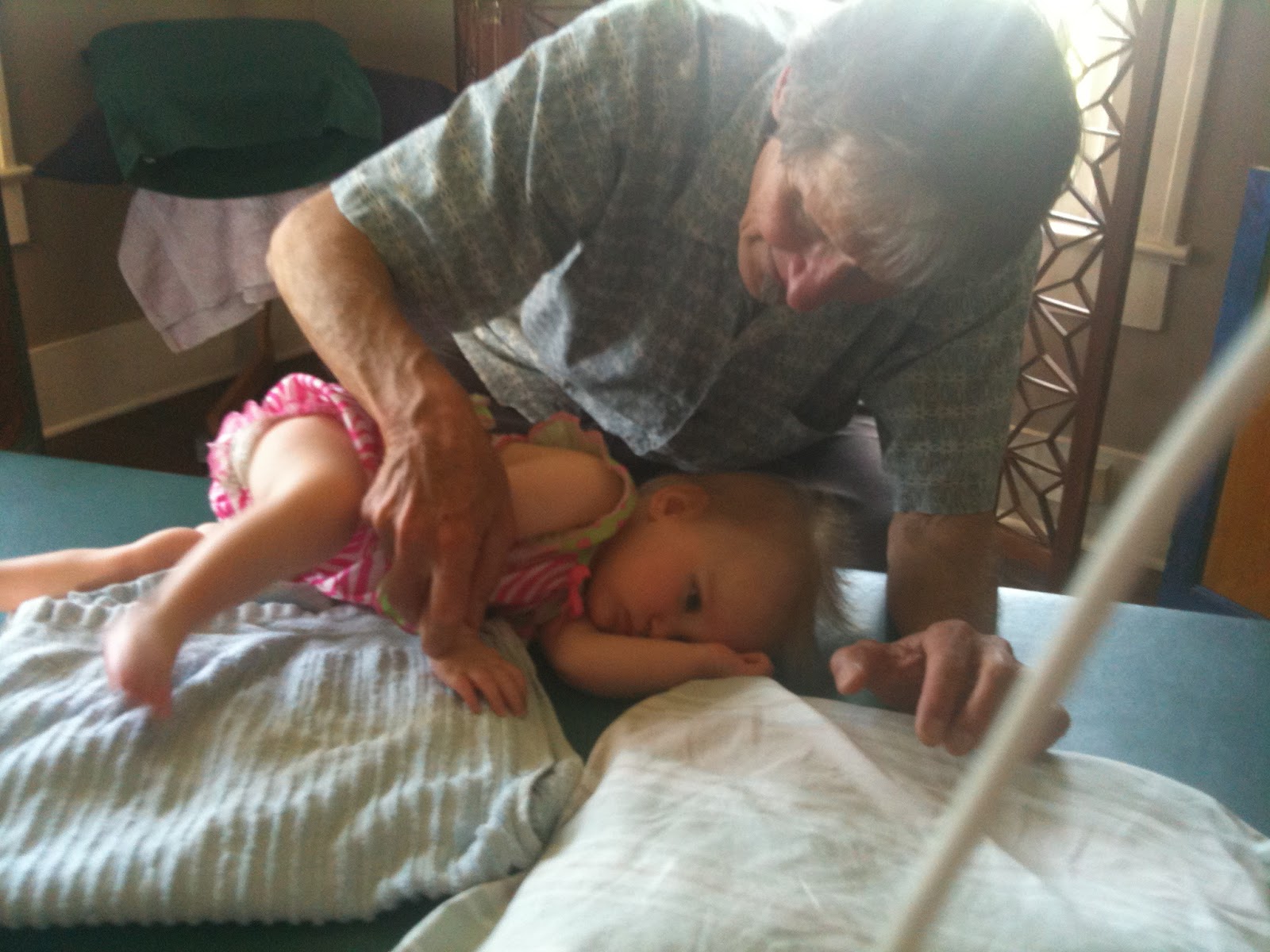
Variation on what to do with the left hand. Notice how attentive Harper is.


Once, when working with a boy who seemed to have a habit of getting
into a funk
and whining and clinging to his mother,
I stopped trying to work on anything else,
stopped hoping or attempting to distract him to
"more important" learning, and focused in on the whining.

I asked him to raise his pitch, giving him an example.

I asked him to lower the pitch of the whining, giving another example.

I asked for the whining to come in burst of two, and in patterns of three.

I asked for louder.

I asked for softer.

He was game for all of this, and the whining became a game to him.

When I mentioned this latter to Anat, she commented that until we'd brought
variation into the picture, he may well have had no idea that the whining was his action.

Once we made a game of it, and gave his action lots of variations he could control,
his distress went away,
his pleasure in life went up,
and his brain got back on the track of being a learning organism.

He could tell the differences.
He could make the differences.
He made a difference from his awareness and his choosing different actions.

In another case I'll always remember, Anat was supervising about 6 different student practitioners, who had taken 10 basic segments of training, and now where on their first Special Needs Children segment.

On one of the tables, an autistic boy was busy throwing this and throwing that, clearly just working out .....? Who knows what.

Anat came by the table and asked him to make choices: did he want to throw the toy dog, or the ball off the table? Did he want to throw the book or the truck?

And so on.

This satisfied and calmed the young man, and after that, Anat advised the student practitioner to work slowly, and verbalize each action she was doing: "Now I am moving your arm, holding your elbow." "Now I am moving your leg, holding your foot. I am rotating it this way and that way."

That was all for the rest of the thirty minutes.

The child went home and apparently verbalized in ways that he never had before.

.........

In Anat Baniel's new book: Kids Beyond Limits

Anat very clearly not only explains:

One: research with rats and with humans (learning the game of Go), that supports Variation as the key to improving the brain and improving the learning.

Two: gives an inspiring example of a small boy who came to her essentially trapped in his conditioning after many months in a full body cast.

Three: gives examples of playing / learning games parents can use with their children to increase the enjoyment of their interaction, and the quality of their child's brain (and the movement, too, as the by product)

Four:
Clues us in to some valuable concepts we can use in our own lives, as we as helping the children:

Such as: (And these are in bold in the book, too)

Think of your child's mistakes as a wonderfully rich source of Variation
(And therefore, never correct mistakes. Use them as jumping boards for more and easier and more fun learning.)

Without light the eyes cannot see. Without Variation the brain cannot learn or organize action very well. 

..........

In Anat's article for Massage Therapy magazine,
called New Possibilities: A revolutionary approach to special needs children

Anat says this about variation:

"The more new variations the child experiences, the better and faster his brain can differentiate and form new solutions. The child learns how to learn. Without variation, we starve the brain of the new information it craves, no matter how hard the practitioner and child try, the outcomes will be very limited until you provide these variations. If the child is unable to do what the practitioner is trying to have him do, then something new needs to be introduced. If the child can already do what you are offering, it is time to move the child forward into his next level of functioning"

......
The chapter in her book says plenty more, but I can't copy it off the Internet so at $10.88 from Amazon, I'd recommend getting three copies, one for one and the other two for grandparents, or OT, PT, caregivers, anyone who comes to your child and would love to know how to be far more helpful, and how to stop unintentional strategies that are actually hindering your child's learning.

Saturday, April 07, 2012

Yesterday is gone, one more healing game

YESTERDAY IS GONE


[One of the great glories of the past: It is over.]


Think of an argument or a disagreement you have about something your partner, even your imaginary partner, did in the past.
Look at them, or imagine them in the present.
Feel, breathe, sense, aware your world in the present.
Then go back to the “story” about how the past “should have been different.”
Then come back to the present.

Look at them.
Say this: “I can go into the past and make myself….(sad, unhappy, angry, etc, you fill in the blank) with this story {{{ gibberish, gibberish, gibberish}}}. Or I can be present and notice this…..(fill in the blank with the present).”

Go back and forth on this for ten to twenty minutes.
Feel the calming wonderful peace of the now.
Good.

Thursday, April 05, 2012

Time is for beginners, breath is for finishers

In addition to writing mystical mumbo jumbo, and working with couples and teenage/parent pairs who want to double their communication and love happiness,
I work with special needs children,
using the miraculous Anat Baniel Method.
Anat's new book is out and can be read about at
Kids Beyond Limits.


You can hurry through reading this post,
because what's for real is imagined to be a little later,
after this now,
just a bit down the road
and if we clear away all the hurried items
we can chill

maybe even turn off the computer and
chill

or at the very least look up and away
and see some sky or trees,

and if it's night,
where is the nature we could be using to nourish us
to slow
down
and remember the big news

the main thing:
we are alive now,
(we are alive now,
repeat, without words:
alive
now)

this is the miracle

we move our eyes over the words and our spine holds
up our head and the ribs are attached to the spine and they
rise and fall according to our breathing

and we could notice our breathing

right now

as a doorway to returning to the now,
following and noticing our breathing is
a recommended route for many years, millenia
as it where

Buddha said to back away from all the dreams
of the mind
and come back to reality

Jesus said to hitch your star to the giving away
of all the possessions,
as in "My idea...," "My country....,"My political important opinions..."

Give them up, and what is left?

The breath is left if we are still alive.
And some part of us can watch the breath if we are aware.

And some part of us can giggle at the enormity of it:
us, the living thing, being, spirit, whatever we are,
(that we don't have to verbalize if we take Buddha's vacation
from concepts),
we are alive and have awareness of being alive.

And does that take much time to do?

Nah,
more like taking a little time away from time,
consulting our inner happiness and asking it:
hey, what's up with this happiness and being alive
thing?

And it will answer:
Yes.


Therefore: stopwatch, watch the time, watch the phone's which are the new watches:
be on time, time yourself, hurry up, get too much done, all
that is for beginners.

And a nice game to be able to play
when YOU choose to play it.

And then there is the real game:
the I am alive,
Right Now,
game.

That's a pretty good one, too,
not to be talked about,
and even written about too much,

just to be lived,
experienced,
en joyed
and the gratitude,

sure,
how can that not be the flooding
out feeling underneath it all

the gift we have been given:
I am alive,
you, too

good

Wednesday, April 04, 2012

the importance of love, 33


We wake up
one day
or part of one day
or
Right Now

and realize:
I am
I am alive, whatever that "alive" is

and it feels so good
we want to share it
with someone
hug someone
laugh with smile with joke with dance with prance with
hop skip and jump
or
just walk

or even better: lolligag
with another, backs on the grass,
or butts on the stream bank
watching the water
watching the clouds

glad to be alive
together

and there are problems to be solved
money to be made
conflicts to be resolved
pains to be understand and transformed

there is a world to be healed
and waters to be restored
and oceans and indigenous plants and people to
be "saved"

and still
you and a loved one
walk dance hug loving
lolligaging,
talking the truth,
but the slow real truth about you,
not the "you need to fix this" pseudo-truth about them

just you and the friend
in love

that's a nice part
of a nice
day

wishing these for you,
many parts
in
many days

Tuesday, April 03, 2012

Love is Easy, except it often feels like "losing"


You are having this argument
"thing,"
you and your sweetie are,

and it's the damndest thing:
they think they are right and you are wrong,
and you think you are right and they are wrong

Sometimes, one of you will cave in,
or be argued under,
or start to cry,
and then maybe the battle will cease,

but
who was the one in you that wanted to be Right?

This is an enlightenment question.

Really.
What part of you was so sure that you had been "wronged,"
or that the other person was "wrong,"
or that you were the Victim,
or that whatever went down SHOULDN'T HAVE HAPPENED

 Which is to say,
what part of you wants to be the one
that says how
reality should be?

Which is to say,
who runs this show, anyway?

......
You may be following me.

You may not.

Don't worry.
Think back to a time when you were SURE the other person
was wrong.

Find the part of you that is so sure.

Where does this part live?

What is it made up of?

What does it live for?

What is it all about?

And then think about/ and remember the miracle:
you are alive.

Now.

And experience that,
without any part to describe it,
or catalog it,
or talk about it,
or explain it.

Just experience your aliveness
in this moment.

That's you.

And see,
honestly,
does that you,
want to be right?

This isn't theory.
This is practice.

Love is enlightenment when the tests
come up.
When the hurdles arise.

Leap over.,

See who is leaping,
and what you are like,
when free that way.

And it's not a long way off.


It is, of course, right here now.

Good.

YOU ARE WHAT YOU EAT ATE


This is inspired by watching my friend,
George Altgelt,
owner and proprietor of GeoGrowers soil making company
near Austin/Fredricksburg,Texas
talk about how important feeding our soil is.

The VIDEO interview with him is here:
INTERVIEW WITH GEORGE ALTGELT

The point is that if you feed the soil, then your vegetables, and trees
and flowers will be so much happier.

YOU ARE WHAT YOU EAT ATE

Feed your spinach organic soil and it will have 83 times more iron than
inorganic spinach.

Feed the meat you eat grass and they will be an omega-3 shot for brain and protein blast for your body.

Feed them the normal feedlot, stress life and GMO food and they will be a cancer bomb.

PS: These statements have not been validated by the FDA, but the 83 times iron is from published research of which George, above mentioned, actually knows the specific source.  

So, what is this blog posting about?

YOU ARE WHAT YOU EAT ATE

Monday, April 02, 2012

Special Needs Children, Monday Post: milestone vs learning

(Even with her hand "fixed" in her mouth: 
the difference between hand and elbow,
and between elbow not bearing weight vs elbow bearing weight 
is HUGE in this moment for Harper)


Here's the Normal Doidge quote again, bold and all:


"Following in the footsteps of the revolutionary scientist-clinician Moshe Feldenkrais,

 the greatest thinker about how to improve movement in the twentieth century, 
[Anat] Baniel show why our mainstream approach to these children is often wrong, and at times damaging, 
because they train the children 
to 'ape' developmental milestone they are not developmentally ready to meet. 

The approach here, 
far wiser, far more subtle, 
truly holistic, far more ingenious, 
far more in accord with how brain development occurs, 
show ways to access the child's OWN brain plasticity, 
and yields far greater results, so that the children can spontaneous grow from within."

I broke it down into pieces,
and maybe it's easier to read that way.

If so, that itself begins to illustrate the genius of the Anat Baniel Method and the Feldenkrais method:
it's about discovering the pieces to learning, not trying to
get the child to do what the child can't do.

I'll say that last part again, because I've seen PT and OT and good meaning body workers
over and over do this,
with children,
with injured adults,
with themselves.

If something doesn't work, the main goal
of the "fixers" is to
get the thing that Doesn't Work
to Work.

(Like when someone tells you: Say something funny,
and you aren't in a good mood.)

Now, with an adult, whose shoulder "used" to work,
whirling away "trying" to improve "range of motion,"
though painful and ineffective, is not necessarily harmful.

Well, actually it is harmful,  but not in the massive way
this approach is to a child.

Think about it:
A child can't sit.

The developmental milestone of their age is to sit.

So someone shoves, pushes, helps, prods, pads the child into sitting.

Since the child doesn't have the pieces and the learning of pelvis and ribs and head
and back and shoulders to sit, what does it learn?

Failure.

It learns that people are trying to get it to do something
and it is going to fail over and over and over.

What is missing is not the "how to sit" program, but the brain's awareness
of all sort of small differences that make up sitting.

As Anat clarifies it in her book:
(Kids Beyond Limits)
the brain needs to/ loves to/ wants to/ is designed to
DISCOVER that
Thing One
is
different than 
Thing Two.

I just finished a section in the book, describing her work with an autistic boy
who could barely speak,
and could hold toys only for brief periods
and seemed unable to finish any sentences.

She helped him distinguish Thing One
and Thing Two
of back and shoulder
and
back and head

and one finger from another
and one hand from another

his speech and his drooling and his thinking
all rapidly improved

no work on speech or drooling or thinking
but
he could and wanted to live at a more complex level.
Why:
  his brain had become more clued in and excited
to be doing what a brain is meant to do:
distinguish differences.

Or better said:
Learning is distinguishing differences
that make a difference.

( If you are married, try this for a difference that makes a difference:
Thinking and saying: "Why don't you stop doing....." when there is unwanted behavior.
Vs
wondering and asking: "Is something bothering you?")

Wednesday, March 28, 2012

Two quotes from Kids Beyond Limits, both way at the beginning: Life is Transformation, remember, remember, remember

Anat Baniel doing her gentle "magic", i.e. helping this child's brain rewire to a higher and more advanced level, touch by gentle touch


From Anat's first page:

"Just yesterday I saw, for the first time, a fourteen-year-old boy who had suffered severe brain damage in infancy. The injury had left him blind, with no language abilities and with no voluntary movement. After just a few days of sessions with my colleagues and just one sessions with me, for the first time in his life he began vocalizing and moving his legs; his arms were freer, and it was clear that he was engaged in the process --- he was even able to follow some simple movement instructions I gave him-- and loving it. He was waking up to himself."


From Norman Dodge, MD, author of The Brain that Changes Itself:

"Following in the footsteps of the revolutionary scientist-clinician Moshe Feldenkrais, the greatest thinker about how to improve movement in the twentieth century, [Anat] Baniel show why our mainstream approach to these children is often wrong, and at times damaging, because they train the children to 'ape' developmental milestone they are not developmentally ready to meet. The approach here, far wiser, far more subtle, truly holistic, far more ingenious, far more in accord with how brain development occurs, show ways to access the child's OWN brain plasticity, and yields far greater results, so that the children can spontaneous grow from within."


His intro is longer. Anat has a whole book to take parents through her nine essentials.

Please jump to her webpage, read more about it,
and BUY AND USE THE BOOK.


http://www.anatbanielmethod.com/children/kids-beyond-limits

EVERY DAY USE IT.  ( Your brain will love it, too.)

To feel sad is not bad, it's just...


there is no law against
feeling sad
feeling bad

and then we walk outside
and the sky doesn't feel
bad
how is that

and the sun,
no matter how many clouds behind
which it is hidden
doesn't feel bad
and
why is that?

and the birds seem to sing each
day
without complaint

and still
feeling sad is no crime

it's just time
we are choosing to spend
that way?

there is a message of course,
several
many:

who is the one feeling sad?

is that the really really you?

what is the sad story
and is it true?

and true to whom?
to the real you that is like the bird
and sky
and stars
and rain
and trees

or the ????? one
who is a collection a rag tag conglomerate
of fables and shoulds and shouldn'ts and this is
how others see me
and this is what I've told myself I am

and
meanwhile the
birds sing

and our hearts beat
and our lungs breathe
and the gravity of the situation
holds us from flying off into space

which is what it can feel like
when the story disappears

we float
we rise about "it"
and
the pretend chains
that our words and minds embrace

and then a bit of stillness
and
....
poof

no more sadness

and not because we wished or pushed
(or affirmed) it away

we just stopped the tie
to its fuel

and all that was left
was
now

and now
was so big and bright

is so big and bright

that we shine huge
vast
unknown
and peaceful

like the stars
in the night

Tuesday, March 27, 2012

Want a great relationship: Tell the truth. All of it.

Another great photo by Michelle, at mischelle@zahavah.com


I am attracted to .....

I get jealous when you...

I forgot to tell you that .......

I have this feeling that.....

Something is bothering me, and I don't know what it is....

My stomach feels weird.....

I've been feeling that something is missing.....

I had a dream about......

This used to turn me on, but something is changing.

I need time to myself.

I want to talk about my life purpose. I need a listener.

I feel like we are forgetting something important.

Who am I really?

Who are you?


And so on...

If you want a fantastic relationship: tell the truth.
All of the truth.
Good.

PS:
Anat Baniel's New Book:


is out, published.

If you have a friend with a special needs child,
or a brain
that wouldn't mind getting smarter
or
a body
that wouldn't mind feeling younger, happier, sexier, more comfortable and "smart"
get the book.

Sunday, March 25, 2012

I am alive, you are alive, deepening the relationship, day two


Day Two is a deepening of day one.
Here's the exercise.
Go slow. Go slowly. Go slower.

If you are alone. Think of another person. Someone you love. Someone you hate. Someone you want to feel better about. Someone you want to understand better. Someone you want to help. Someone you think has "done you wrong."

Pick just one person, and imagine them in front of you while you do this. Imagine looking into each others' eyes.

1. Breathe.
Follow your breathing.
Notice the other person's breath.
Match their breathing.

This will be shorthanded in the following as:
Breathe.
Notice.
Match.

After matching for awhile:
Say: "I am alive."
And then match breathing a bit more.
Say: "You are alive."
Match.

2. Now, in one sentence increments say:
"This is what it's like being alive, right now."
Only report on your immediate experience.

If thoughts of the past come up, say, frustration at work,
do not say,
"To be alive right now is to be frustrated at work."
Say: "To be alive right now is to have memories/ thoughts of work, and when I have those thoughts I feel ....."

Between each reporting of your life in the moment, go back to
Breathe.
Notice.
Match.

Then say the next: "This is what it is to be alive right now."

Do this three or four sentences, but no more.

Then just be quiet and notice you aliveness
AND their aliveness.

3. Say this truth:
"I am going to die someday."
Breathe.
Notice.
Match.
"You are going to die someday."
Breathe.
Notice.
Match.

4. And then one more sentence:
"This is what it is like to be alive right now....."

5. A final
Breathe.
Notice.
Match.

And then trade turns.

Go slow.
Did I say that.
Go slower and be present.

Let this sink in.
This is all you really need to know.
So, in case you missed the hints: go slowly, and
Breathe.
Notice.
Match.


Good.

Friday, March 23, 2012

Divorce and Enlightenment


Many people think of divorce as "failure" and use that as an excuse to feel bad.

Failing means that something didn't work.

That means you tried something.

The trick, and the deep trick, is to get excited about
1. having tried
2. what you set out to do
3. how you undermined, or didn't understand, how to achieve what you set out to do

Notice this doesn't say: figure our how your partner made it impossible for you to achieve what you set out to do.

And notice we are begging the question of most people not really knowing what they are setting out to do when they enter a relationship or a marriage.

So, having a vague idea of "happiness and a family," or "true love," or at best "mutual support," things get ragged at times, and since we have parents who usually didn't have fine and kind and awakened ways of dealing with issues, we fall back on bad models of behavior.

And get bad results.

And still : we tried for something.

Admit it. You tried.
If the aim wasn't clear , let's get excited: what could our aim have been.
( and a negative formulation is often a set up for poor results, a formulation like: not so much fighting, someone who doesn't put me down, someone who isn't ocd, or nagging, or whatever the X was; to look for "not the X" is a shadowy path to future happiness. Admit it, and even smile and your temptation, if you are in the looking for a "new one" mode.)

Here's some gold in divorce: what did we really want and were afraid to say aloud
( and gads, admit this, too, that we were too lazy to search for a non negative formulation of what we wanted).

What did you want?
What did you wish you'd said you'd wanted?

And here's more gold: what were you wanting from the other that you were not yet willing to give to yourself.

Say you don't appreciate yourself. And yet you were waiting around for your partner to appreciate you.

Or, you aren't particularly happy. And you are annoyed with (yes and unhappy about) your partner being unhappy

All this has a quick, straightforward and more or less guaranteed "cure" via the Work of Byron Katie.

Was doing this work a part of how you set about to accomplish the goals of your relationship?

Will it be part of your next relationship?

And what has this got to do with enlightenment?

Enlightenment is being present. To the now.

It is letting go of stories about how reality should be different than it is. And one of the major places that we love to complain about and demand that reality be different is in our relationships.

So we can take divorce, and its accompanying pain,  as a grand opportunity to realize who we could be when we let go of our "story" about this other person,
instead of doing the usual "my X was a jerk/ sociopath/ dope/ abuser/ creep" and discover how our judgments and demands and criticisms and inability to listen and withdrawing and attacking, how we piled fuel on the flames of unhappiness.

We can learn to have unconditional love for this person who we have separated from.

In a way that's easier, since their so called "annoying" traits we don't have to live with day to day.
But if we can't love everything about them, we don't know how to love yet.

And to be enlightened is to love reality. If this person isn't breaking laws and physically hurting people (in which case there are police person about, ready and willing to help them stop), then we should be able to love them from afar.

If we can't, the news is sad: we can't love ourselves.

Which means we aren't ready for a new relationship yet.

Which means we aren't ready for happiness yet.

Happiness is not necessarily the goal of life, but not being happy is always a sign that we are not in the present and not in love with life.

In other words, not enlightened.

Weird to give enlightenment the freight of taking us out of our misery, but guess what? That's what our misery is for: to wake us out of our trance and get us to work on the real work of letting go of our judgments about ourselves and others.

And the first step, according to the work of Byron Katie, is to be honest. To judge.

Judge yourself and your neighbors.
Write it down
Ask four questions.
Turn it around

Good. If you are divorcing or in a troubled relationship, do the work, or keep suffering, or hide from it in jogging or overeating or new sex or lots of movies or overworking.

Life is choices.

I think to wake up one is best, and you get to decide for you.

Wednesday, March 21, 2012

the game of enlightenment


enlightenment
has a fine reputation
as something kind of cool

and maybe it is

maybe not

light is good

shedding light on the real
is good

shedding our suffering seems
a worthy way to be

shedding our grasping to be better
than others
or to be right
or to not have to shift to see the next thing that
is coming along

shedding
letting go
taking it easy

waking up to the moment

all that seems like a good thing

and is it?

Who knows?

and the who that knows or not knows
is .....?

what if our experience is
a nice indicator of our life
right now

and what else could it be

experiencing this moment
can have all sorts of concepts about
how cool that that is

but just the moment
the experiencing
the whatever us/ not us experiencing the
flow

that works as a life
that is lived
without moorings
but with lots of joy
and juice

and is that true?

who knows?

try living this way
experiencing this way
juicing into all this
chunk by chunk
breath by breath
laugh by laugh

nowwhere to go
no where is better
and now
waits
and is already here

and it's over

good

Tuesday, March 20, 2012

Relationship Enlightenment, Day Seven : Now vs "the feelings"

This is also published in RelationshipEnlightenment.blogspot.com


In relationship, we get these feelings.

You know the ones: anger, fear, frustration, neediness, jealousy, worry, sad, lonely, overwhelmed, underwhelmed, confused.

A grand thing to do with those and any feelings in the work of Byron Katie, and that will be the last seven days of our 21 day program. Her work is all of therapy wrapped up in a simplicity and elegance that not only "heals" the various emotional wounds we are carrying around, but can carry us to the enlightened state if we just keep asking: "Is it true?" and "Who are I without the story?"

But for now, today,, let's play with understanding our loss when we leave the present.

You can do this with your partner.

You can do this alone.

Give yourself some time, and allow yourself to "go to" the feeling that is most disturbing you right now.

Say aloud that feeling in it's shortest form:
"I feel angry."
"I feel sad."
"I feel afraid."

Skip the "I am..." form. Why? Because who you are is vast, so much more vast than any mere feeling, or thought, or set of words, or concepts.

So, just say the feeling without any of the becauses.
(You know; "I feel angry because you never come home when you say you will." No, stay small, stay direct, stay with yourself: "I feel angry.")

2. Whether alone or with your partner, fill in the "because" part of the feeling, but make it spoken in gibberish.
"I feel angry because ......NFNEIFH JJKIUMO  NNORYQPVAB." Make up sounds and convey the feeling of your big bad sad angry hurt victim story about how much they are "doing it wrong."

But don't actually say the words.

This gets you a step away from taking it so seriously, or maybe several steps.

If you are in front of your partner, it spares them all the blame about why you imagine you are feeling as you are feeling.

3. Pause. Breathe. Look at your partner. Smile.
Feel your breathing.
Watch their breathing.
Say aloud: "I am alive and breathing." Pause and notice your breathing. As you do so watch their breathing at the same time.
Say aloud: "You are alive and breathing." Pause and notice both your breathing.
Notice them in the light.
Say one or two things you notice in the present from the information light is bringing into your eyes.
"I see you looking at me." "Your shirt is blue."
No, no, no interpretations.

4. Go back to the feeling.
Explore when in the past you felt that way.
Talk about when in the past you felt that way.

5. As you talk about the past, which isn't in the present,
notice,
in the present,
IN THE PRESENT NOTICE,
your sensations in your body. Your chest. Your skin. Your neck. Your eyes. Your legs and arms and spine.
Some might feel tense, usually around the torso area. Some areas might be just fine, say your feet and ankles.
Report the physical sensations that go along with talking about and exploring this feeling and it's roots in the past.

6. Pause and go back to #3. Notice what being alive in the present is about.

Go through the breathing and saying the truths of that section.

7. Keep looking at your partner ( if alone, imagine whomever you are having the feeling about).
Switch between them in the present,
them in some past where they were triggering the feeling,
and
the past persons who triggered this feeling first.

Go back and forth.
Notice how calm the present can be.

Notice the agitation of going back to the "story" of their "crime."

Notice the difference between your partner ( or annoyance person, for this can be an X, with whom you need closure) and the person from your more distant past.

Notice the three possibilities:
the way past woundedness ( and how does that feel in your body)

the slightly past woundedness, when you go into the story about your partner or whomever

the present.

8. Come back to awareness of yourself in the present.
Say aloud, sensing yourself and noticing your breathing and theirs:
"I am alive. You are alive. I am breathing. You are breathing.
I am going to die.
You are going to die."

Have some quiet time, to walk, or rest, and then repeat the process the other way around if you have both people in the same room.

Give yourself lots of time.
Do not explain the gibberish, even if they know.
Do not "defend" yourself against the gibberish, even if it's obvious what it is.
Do not "help" the other with their past feelings. Especially do not go into: I told you so, you weren't really angry at me, I knew all along it was your father.

If you want to be grateful for the present, or for the other person, and to express that.
That would be a fine idea.

Good.

Monday, March 19, 2012

Fund Raisining for Special Needs Children Parents: going beyond the comforable

This was published also in my blog:
SpecialNeedsChildren-chriselms.blogspot.com


Children are expensive.

Special needs children are very expensive.

Hillary Clinton's book title helped us all remember what we all kind of knew:

"IT TAKES A VILLAGE TO RAISE A CHILD."

This is even more true with a special needs child.

As anyone reading this blog knows, I consider the Anat Baniel Method one of the finest
methods to get the brains and bodies of these wonderful children catching up with their peers.

The method is based on slow and gentle and variation and turning on the learning switch and more.
You can read about that in Anat's already published book, Move into Life.
And soon you can read about it ( March 27) in her new book: Kids Without Limits.

But for now, I want to encourage all special needs parents to step up their skills and their
courage and reach out to several villages, or the a BIG VILLAGE to fund raise for their child's
expenses.

Not only are the ABM lessons a fair but high price, but there are travel expenses, and medical expenses, and baby sitting expenses and much more. Parents know far better than I.

I have recently, in Dallas, completed my certification for David Neagle's Money Miracle Coaching.

Several of his key concepts seem especially useful to special needs children parents who might be hesitant to fund raise actively for their child's expenses:

1) If there is a need, the money is available, here in your life, right now to meet that need.

2) This money doesn't fall from heaven the way many of the "Law of Attraction" folk seem to imagine, but is available as an Opportunity that exists. Right now.

3) To take advantage of that opportunity always demands we step up to a higher level of who we can be. The old level couldn't see the opportunity, or would be afraid to make moves that a uncomfortable to make our new reality possible. The new level can see the opportunity and create what seem like miracles.

(This is totally in line with the ABM lessons, which always test out and provide new ways to move, trying always something easy, but something beyond the "comfortable" and routine of the established range of possibilities. Notice I did NOT say range of motion. ABM is about brains, and their amazing ability to learn and learn and learn.)

4) The more we take advantage of new opportunities the more we see the old excuses of
NOT NOW ( later we can get the changes we want)
and TOO EXPENSIVE (the new so often requires us to expand our definitions of what we can desire, what we can bring in, what we can spend).

The underlying attitude is one of amazingly benevolent spirituality: That God would create a need in us that He didn't create a way for us to satisfy.

So, with special needs children: You didn't sign up to be fund raisers, and you didn't sign up to be a special needs child parent, but the people you will meet, the skills you will establish, the hope for your child and humanity that you will engender all will be that famous "blessing in disguise" that so much of times "hard times" bring to us.

I encourage you to think big, two or three times even the amount you think would "just get by."

There are people in your community with a great deal of money, and big hearts. You might not know how to find them yet, but ask, find the connections. Somehow the necessary links will take place.

Keep track of what you are learning, so later you can help and teach other special needs children parents how to do this, too.

God bless you and enjoy the learning, enjoy going beyond your habits, enjoy expanding out into an even more amazing you.

Chris
March 19, 2012

Friday, March 16, 2012

Aging, "Anti-aging," reversing the clock, waking back up to life


Say you took a walk down a narrow path to a river each day, fetched some water and then carried it back up to your village.

Then you picked some fruit from a tree, perhaps climbing up the tree, and if the day got too hot you swam and splash in the river down below, so once again a walk of attention (the path is narrow and you could fall off) and back up: nice exercise.

You hunt or you make baskets or you cook food or you prepare weapons or you take a nap or you talk to the grandchildren or children or adults or grandfathers.

You move, you pick up things from the ground, you harvest roots, you skin any animals you have killed.

It sounds primitive and could have it's own charm and appeal or could be a horrifying life to us "moderns", what with food in grocery stories and cars to carry us to work to make money to drive home via the market and cook our food in convenient ways that require no bending down to light the fire or pick up the firewood.

We don't move much, and some go to a gym and push various machines and barbells and metal around, and that certain helps, but the overall picture is one of a lot of sitting. At desks. In front of computers.

And then, even on the part of the day we used to just walk to the car, we are on the cell phone, and now it's a smart phone, so our eyes are glued to the little one and a quarter by three inch screen.

We hunker around our little electronic communication network, not around the fire, not around the circle of family and friends telling stories.

Movies tell our stories, and less and less people even sit with others watching the mutual dream. We stay home, we get our Netflicks, and probably a big chunk of that time is also spend texting and gazing at the even smaller screen.

People are missing. Movement is missing. Nature is missing.

And so we age.

People in the tribes in the old paradigm aged too, but their bodies stayed relatively mobile and their minds, with real problems to solve, real pathways to negotiate with real sleep, stayed alert. The elders job was to pass on the lore and the skills to the young. The young are figgity and keeping up with their minds and bodies must have kept the elders way more on their toes, literally, than the shoved off in old folks homes, and dimming away to Alzheimers, and decaying into the cancer plague.

And does Feldenkrais and Anat Baniel have something to offer the modern woman and man, the modern desk ridden, car enslaved, smart phone addicted person.

Sure.

It has a plethora of movements, that are slow enough to be engaging on their own.

Movements that vary, and so the brain has to pay attention, and even better new neural pathways are laid down. And this is learning.

We try things in a new way, with attention, and learning, real learning of new connections gets hooked up in our brains.

And the spine lengthens, almost always with either table or group lessons. All the moving this way and moving that reminds the vertebrae: hey, you guys aren't a rod, you are a chain of linked and separate units, and the more you can remember and move in all directions with some separation from how your neighbor is moving, the more the spine can lengthen out.

The hunching over of the old, as the spine gets more and more trapped in the patterns of a life time of slouching, this can begin to "un-do" with the lessons of this work.  In the old days, people picked up things from the ground, reached up to climb and pick fruit, rotated right and left to follow prey and avoid danger and get through various openings. We can create, in gobs of fun and different ways, bends and arches and twists and sidebends in our spine.

We can recapture the joy of having a body that is excited to learn something just a little new each day.

So it isn't really "anti-aging," we don't have anything against aging. It's "anti letting ourselves stop learning, and anti falling into deeper and deeper immobility, and anti thinking we have reached the know it all stage of existence.

It's anti fear of the new, but excitement, and this can spill over.

What new will life bring today?

It's so exciting. Let's find out!


Wednesday, March 14, 2012

The importance of forgiving ourselves


It's like this: we aren't perfect.
Or, wait a minute: we are perfect, but according to some rules, we are less than we want to be.

Or, we actually do stupid, or mean, or thoughtless, or selfish things now and then. And then we have the present to live in.

Now is all we really have.
If we "blew it" in the past, we cannot undo that, and an attitude of harshness towards ourselves only makes it more likely we will act poorly in the future.

Because when we lash out at ourselves, we feel bad.
And when we feel bad, we treat other people not as well as they deserve. Not as well as we wish to treat them.

These people around us are miracles. They are alive.

We are miracles. We are alive.

In the present we can realize that, can feel our life right now, even reading or hearing these words.
And if there is another person in our life, and we think of them, we can feel in our hearts the glory of this: they are alive.

So what's this go to do with forgiveness?

Holding onto an image of ourselves that's impossible to match in reality causes stress, at the very least.
And the image is: we should have been different in the past.

Now, we can examine the past and imagine that being different would have created different results.
And we can try different actions in the present to create different results.
But we can't erase the past.

And we can look at the imaginary self of us in the past, and pat ourselves on the head and realize we did the best we could within whatever mindset we were in.

And we can decide to try a different mindset, and a different set of actions next time. But thrashing ourselves for whatever we did, this leads, as I mentioned above, only to an internal misery that cries out for hurting others so they will match our pain.

How are you in this present moment?

Are you happy and content, glad to be in this moment and alive?
Excited by the prospects of actions and rests you are going to take today?
Feeling your body in gravity, breath, light and sound?
Enjoying the moment?
Knowing you are alive in the moment?
Grateful for the miracle of being alive, right now.

I hope so.


Good.